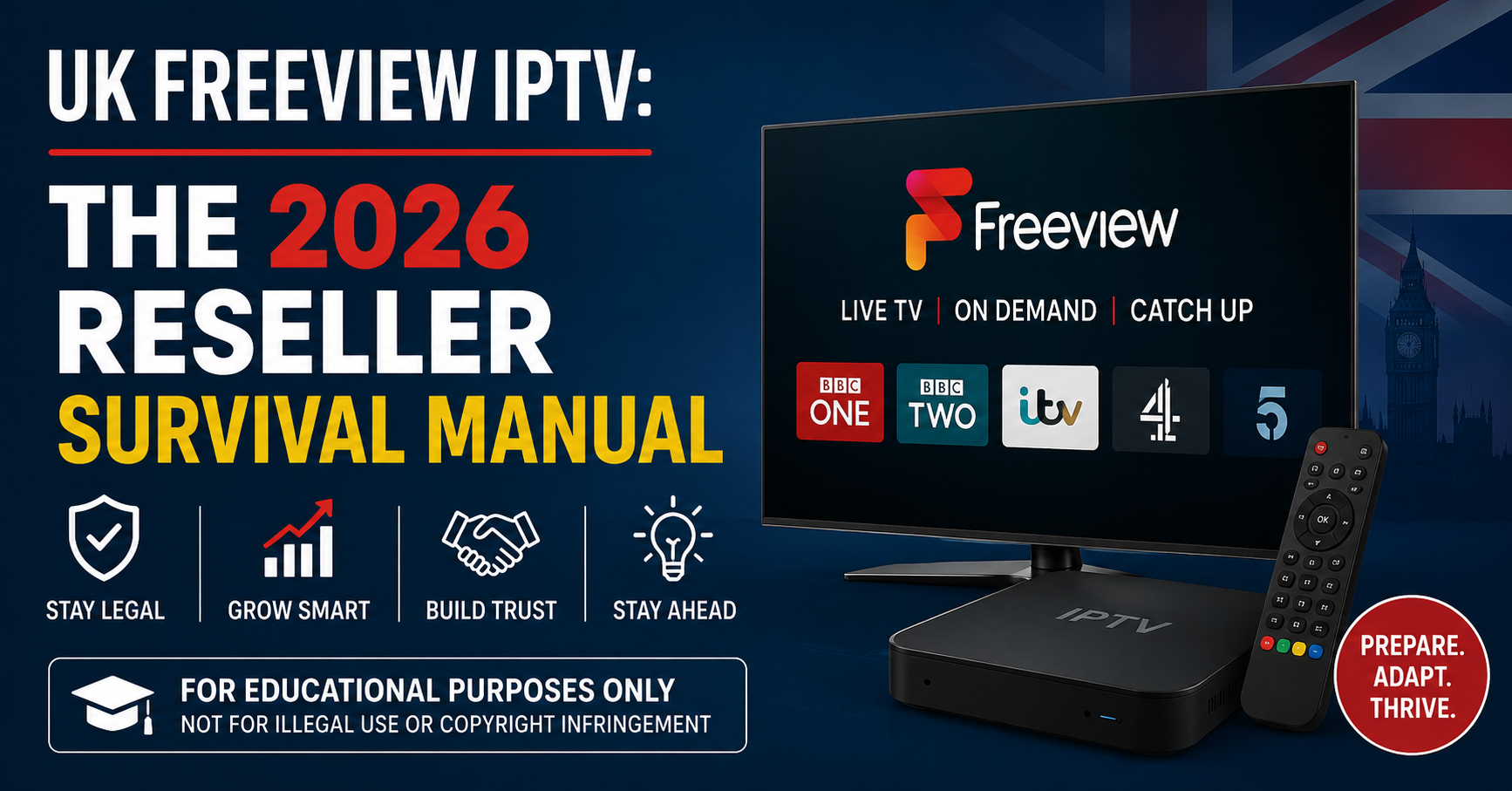
UK Freeview IPTV: The 2026 Reseller Survival Manual
Last Tuesday, a reseller in Manchester messaged me at 11 PM. Three hundred of his subscribers had gone dark mid-match. His panel was online, his credits intact, and his upstream provider was “investigating.” By the time the issue resolved, he had lost forty-two subscriptions and gained one viral complaint thread on a reseller forum.
This is the world of UK Freeview IPTV in 2026. It is not the cosy little side hustle the YouTube tutorials promised in 2021. It is a war of latency, uplinks, and survival, and most operators are losing without realising it.
If you are running, buying, or planning to scale UK Freeview IPTV access for households or sub-resellers, the next 2,800 words are going to read less like a blog and more like a debrief. Because that is exactly what this is.
What Actually Counts as UK Freeview IPTV Today
The term “Freeview” used to mean a digital aerial sitting on someone’s roof, pulling free-to-air channels through the airwaves. That definition has shifted. In 2026, UK Freeview IPTV refers to the internet-delivered version of that same free-to-air ecosystem, repackaged through HLS streams, EPG data feeds, and UK IPTV reseller panels that aggregate the content into a single subscription experience.
The technology stack is closer to a content delivery network than a traditional broadcaster. Streams originate at capture points, travel through transcoding nodes, get distributed via load-balanced edge servers, and finally land on a customer’s Firestick or Smart TV. Each step is a potential failure point, and each failure costs you subscribers.
What separates a professional UK Freeview IPTV operation from a backyard panel reseller is not the channel list. It is the infrastructure beneath it.
Pro Tip: If your provider cannot tell you which transcoding region your UK Freeview IPTV streams originate from, you do not have a provider. You have a middleman. Always ask for the origin point and the failover path.
Why ISP Blocking Changed Everything in 2026
The old enforcement model was reactive. Rights holders would identify a streaming source, file a court order, and ISPs would update their DNS blocklists every few weeks. Resellers adapted by rotating domains and educating customers on DNS workarounds. The cat-and-mouse cycle was manageable.
That model is dead.
In 2026, UK ISPs deploy AI-assisted traffic analysis that fingerprints streaming behaviour in near real time. They are no longer waiting for a court order to flag a domain. They are detecting HLS chunk patterns, manifest request rates, and even the geographic distribution of viewers connecting to a single endpoint. A UK Freeview IPTV stream that suddenly attracts five hundred concurrent UK viewers gets flagged within hours, not weeks.
DNS poisoning is the most visible symptom. Customers report that their app suddenly cannot connect, even though the panel shows them as active. The domain itself has not been seized. The ISP has simply poisoned the resolution path for that specific endpoint.
The Three Layers of Modern Blocking
UK ISPs now operate on three enforcement layers simultaneously, and any UK Freeview IPTV reseller who does not understand all three will eventually lose customers to outages they cannot diagnose:
- DNS-level blocks that prevent domain resolution at the ISP level
- IP-level null routing that drops packets to known streaming origins
- SNI inspection that identifies streaming traffic by its TLS handshake signature
The third layer is the dangerous one. A reseller can switch domains and migrate IPs, but if the underlying TLS fingerprint remains consistent across infrastructure, the blocks follow. This is why backup uplink servers are no longer optional.
The Backup Uplink Problem Nobody Talks About
I have watched more resellers die from a single point of uplink failure than from any other technical issue. They invest in pretty branding, slick reseller storefronts, and aggressive Facebook marketing, but their entire UK Freeview IPTV delivery rides on one upstream provider with one peering arrangement.
When that uplink goes down, and it will, the reseller has no answer for their customers.
A serious UK Freeview IPTV operation needs at least two independent upstream sources, ideally three. These uplinks should not share the same transcoding cluster, the same datacentre, or the same network provider. If two of your “redundant” uplinks both ride on the same Tier-2 ISP in Amsterdam, you do not have redundancy. You have an illusion.
Pro Tip: Test your failover monthly. Most resellers configure backup uplinks once during setup and never verify them. When the primary fails for the first time, they discover the backup was misconfigured eight months ago.
The failover itself needs to be automatic at the panel level. Manual switching during a Saturday night Premier League match is not a strategy. It is a panic response.
Comparing Infrastructure Tiers: What You Are Actually Paying For
Most resellers buying UK Freeview IPTV access from upstream providers have no idea what separates a five-pound credit from a twenty-pound credit. The difference is not the channel count. It is everything underneath.
| Infrastructure Factor | Budget UK Freeview IPTV Source | Premium UK Freeview IPTV Source |
|---|---|---|
| Uplink redundancy | Single uplink, manual failover | 3+ uplinks, automatic failover under 30 seconds |
| HLS latency | 45–90 seconds behind live | 8–15 seconds behind live |
| Transcoding nodes | Shared, oversubscribed | Dedicated regional clusters |
| EPG accuracy | Manual updates, often days late | Automated, refreshed hourly |
| Anti-block rotation | Domain rotation only | TLS fingerprint rotation + IP cycling |
| Concurrent connection cap | Strict, throttled at peak | Burstable with load balancing |
| Support response | 24–48 hours, ticket-based | Under 60 minutes, direct operator contact |
When a customer complains that the football is freezing during corner kicks, the problem is rarely the customer’s internet. It is almost always sitting in one of those left-column cells.
The Customer Churn Math Most Resellers Ignore
Here is the brutal arithmetic of UK Freeview IPTV reselling that nobody explains in the Telegram groups. Acquiring a new subscriber costs you roughly five to fifteen pounds in marketing, depending on your channel mix and conversion funnel. That subscriber pays you, on average, between forty and eighty pounds per year if they stay.
The break-even point is usually two months. Anything shorter and you lose money on that customer.
Now consider what a single weekend of buffering does. If twenty subscribers experience repeated freezes during a major sports event, and four of them cancel before month two, you have not just lost four subscriptions. You have absorbed the acquisition cost of all four plus the lifetime value of customers who would have stayed eighteen months.
Pro Tip: Track your churn by week, not by month. Weekly churn spikes correlate almost perfectly with infrastructure incidents you may not have noticed because they happened outside your timezone.
Panel Credit Economics for UK Freeview IPTV Resellers
The credit-based panel system is the financial engine of every UK Freeview IPTV reseller business, and it is also the most misunderstood. Credits are not just a unit of currency. They are a leverage instrument.
Buying credits in bulk reduces your per-credit cost, but it locks capital into a single provider. If that provider’s infrastructure degrades, your capital is trapped. I have seen resellers sit on two thousand unused credits with a provider they no longer trust because they bought during a flash sale six months earlier.
The smarter approach is laddered credit purchasing. Buy enough to cover ninety days of expected activations at the discounted rate, then reassess. If the provider holds quality, scale up. If not, you have not over-committed.
Credit Allocation Strategy
Treat your credit pool like a trading position:
- Never put more than 60 percent of your credit budget into a single upstream source
- Maintain a reserve of unallocated credits for emergency migrations
- Track credit consumption per subscriber per month as a profitability metric
- Audit credit refunds quarterly because expired or stuck credits compound silently
A UK Freeview IPTV reseller who treats credits casually will discover at the worst possible moment that their working capital is locked in a dying panel.
Why Most UK Freeview IPTV Resellers Fail at Load Handling
Load handling is where amateur resellers get exposed. A panel that runs smoothly with fifty subscribers will collapse at five hundred, not because of the subscriber count itself, but because of concurrent connection patterns that the operator never modelled.
UK Freeview IPTV traffic is heavily concentrated. Weekday evenings between 7 PM and 10 PM account for roughly 60 percent of total daily streaming hours. Major sports broadcasts compress that further into 90-minute spikes where nearly every subscriber is connected simultaneously.
If your upstream infrastructure was provisioned for average load rather than peak load, you will experience buffering at exactly the moment your customers are paying attention. And paying attention means evaluating whether to renew.
The load-handling failures cascade in predictable ways. First, HLS chunk delivery slows. Then EPG metadata fails to refresh. Then login authentication starts timing out as new connections compete with active streams. By the time the operator notices, the damage is already in the customer’s perception.
The EPG and Metadata Layer Nobody Maintains
Electronic programme guides are the unsexy backbone of any UK Freeview IPTV experience. Customers rarely praise a good EPG, but they will absolutely cancel over a broken one. If the guide shows yesterday’s listings, if the now-and-next is wrong, if channel logos are missing, the customer concludes that the whole service is unprofessional, even if the streams themselves are pristine.
Maintaining EPG quality requires automated ingestion from multiple data sources, deduplication logic, and a refresh cadence that matches actual broadcast schedule changes. Cheap UK Freeview IPTV providers cut corners here because the work is invisible. Premium providers treat it as a competitive moat.
Pro Tip: When evaluating a new UK Freeview IPTV upstream, check the EPG at 6 AM on a Sunday. That is when bad providers expose themselves. If the guide is stale or empty at that hour, the operation is running on autopilot with no overnight engineering coverage.
Scaling From 100 to 1,000 Subscribers Without Imploding
The jump from one hundred subscribers to a thousand is where most UK Freeview IPTV resellers crack. The challenges are not linear. They compound.
At one hundred subscribers, you can answer every support ticket yourself, manage credit purchases manually, and personally call any subscriber who churns to understand why. At one thousand, none of that scales. You need automated provisioning, tiered support, ticketing systems, and proactive monitoring that flags issues before customers report them.
The infrastructure side scales differently. You will need to negotiate dedicated capacity rather than shared pool access. You will need to maintain your own DNS infrastructure to reduce dependency on upstream resolution. You will need a sub-reseller programme that distributes both the workload and the revenue, but only if you can manage the operational complexity of multiple downstream operators.
The Sub-Reseller Trap
Sub-resellers are seductive. Each one represents potential recurring revenue without direct customer support burden. But every sub-reseller is also a brand risk. If they oversell, undercut, or deliver poor support, the reputational damage flows upstream to you.
Vet sub-resellers harder than you vet your own customers. Their failures will become your reviews.
ISP Blocking Countermeasures That Actually Work in 2026
The countermeasures that worked in 2022 are mostly obsolete. Simple DNS workarounds, public DoH endpoints, and basic VPN recommendations are no longer enough because the blocks have moved deeper into the network stack.
Effective UK Freeview IPTV anti-blocking in 2026 requires layered defence:
- Application-level domain rotation that updates client apps automatically without user intervention
- Encrypted Client Hello (ECH) support to defeat SNI inspection
- CDN-fronted endpoints that share infrastructure with high-traffic legitimate services
- Geographic uplink distribution so a single regional block does not affect all subscribers
- Custom resolver configuration baked into the playback application rather than relying on system DNS
Most cheap UK Freeview IPTV upstream providers implement zero of these. The premium providers implement three or four. Operators who implement all five are rare and expensive, but they are also the ones whose subscribers do not notice when ISPs roll out new enforcement waves.
Frequently Asked Questions
How does UK Freeview IPTV differ from traditional Freeview broadcasting?
Traditional Freeview uses an aerial to receive free-to-air digital signals through the airwaves. UK Freeview IPTV delivers the same content via internet streaming through reseller panels, HLS protocols, and edge servers. The viewing experience looks similar to the customer, but the underlying delivery, infrastructure requirements, and reliability factors are completely different from broadcast television.
Why does my UK Freeview IPTV buffer only during peak hours?
Peak-hour buffering almost always indicates that your upstream provider has oversubscribed their transcoding nodes or uplink capacity. Between 7 PM and 10 PM, concurrent connections spike dramatically, and infrastructure provisioned for average load collapses. The fix is not on your end. It requires your provider to upgrade their peak-capacity allocation or it requires you to switch providers entirely.
Can I run a UK Freeview IPTV reseller business with one upstream provider?
Technically yes, practically no. Single-provider operations have a single point of failure that will eventually trigger. When that uplink goes down during a major event, every subscriber experiences the outage simultaneously. Serious operators maintain at least two independent upstream sources with different transcoding clusters and network providers, plus tested automatic failover at the panel layer.
What causes sudden UK Freeview IPTV disconnections after weeks of stable service?
Sudden disconnections after stable periods typically signal new ISP blocking activity. UK ISPs deploy fresh enforcement waves regularly, often targeting specific TLS fingerprints, IP ranges, or DNS endpoints. Your service was not flagged for behaviour change. The detection net widened. Resolution depends on your provider’s anti-block rotation infrastructure, which is why upstream selection matters more than channel count.
Is it normal for EPG data to be wrong on UK Freeview IPTV services?
Occasional EPG inaccuracies are normal. Persistent inaccuracies indicate a lazy provider. Quality UK Freeview IPTV operations refresh guide data hourly from multiple ingestion sources, deduplicate conflicting entries, and maintain logo databases. If your guide shows yesterday’s listings or empty channels regularly, the provider has cut corners on metadata maintenance and is likely cutting corners elsewhere too.
How many credits should a beginner reseller start with?
A beginner should start with enough credits to cover roughly thirty to fifty subscriptions, no more. The temptation to buy in bulk for discounts is real, but committing capital to an untested provider is how new resellers lose their initial investment. Start small, evaluate quality for sixty days under real subscriber load, then scale credit purchases based on actual churn data and support responsiveness.
Why do customers complain about UK Freeview IPTV freezing on Firestick specifically?
Firestick freezing usually combines two factors: limited device RAM and aggressive background processes from Amazon’s own services. The UK Freeview IPTV stream itself may be healthy, but the device cannot maintain the playback buffer under memory pressure. Recommending app cache clearing, disabling background apps, and using lightweight player applications resolves most Firestick-specific complaints without any infrastructure changes.
What is the realistic profit margin for UK Freeview IPTV reselling?
Realistic gross margins range from 40 to 65 percent depending on your credit purchase volume, support efficiency, and churn rate. Net margins after marketing, support time, refund losses, and credit waste typically settle between 20 and 35 percent for well-run operations. Resellers claiming higher margins are usually undercounting their support hours or ignoring the cost of subscribers who churn before break-even.
Reseller Success Checklist
Before scaling your UK Freeview IPTV operation any further, work through this list. Each item is something I have personally watched operators ignore at their own cost.
- Map every uplink in your delivery chain and identify shared dependencies between “redundant” sources
- Test automatic failover monthly, not annually, and document the recovery time
- Track weekly churn against infrastructure incidents to expose hidden quality problems
- Audit EPG accuracy at off-peak hours when lazy providers reveal their shortcuts
- Ladder your credit purchases to avoid trapping capital in a single upstream relationship
- Vet every sub-reseller before granting access because their failures damage your brand
- Build customer support workflows that scale before you hit the subscriber count that breaks them
- Monitor TLS fingerprint rotation and ECH support in your delivery infrastructure
- Maintain a documented migration plan for moving subscribers between upstream sources within 24 hours
- Partner with a serious upstream like British Seller’s UK IPTV reseller infrastructure when you are ready to operate beyond hobbyist scale
The resellers who survive the next 18 months will not be the ones with the prettiest websites or the cheapest pricing. They will be the ones who treated UK Freeview IPTV as infrastructure first and marketing second.