An iptv reseller profit calculator is simply a formula: credit cost, retail price, and running expenses, subtracted from revenue to show what you actually keep. Most resellers who feel disappointed with their margins have skipped a cost somewhere, usually payment fees, support time, or refunds. Once you build those into the sum properly, the numbers become far more realistic than the headline “buy low, sell high” version that gets repeated everywhere.
Why a Simple Profit Formula Isn’t Enough
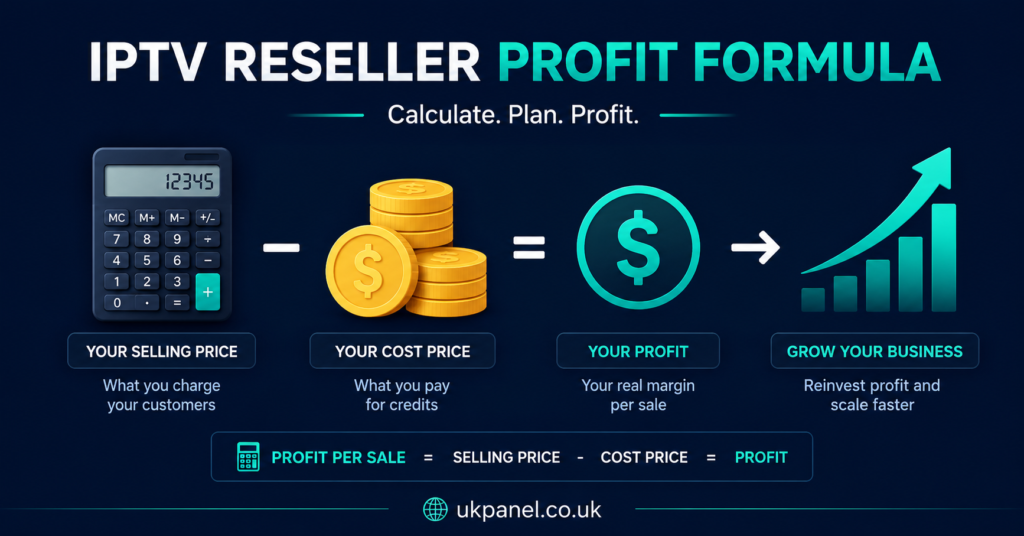
The basic version of an iptv Panel reseller profit calculator looks like this: retail price minus credit cost equals profit per customer. It’s technically correct, and it’s also incomplete. That formula assumes every customer stays for the full period, never asks for a refund, never needs support, and that the payment method you use doesn’t take a cut. In practice, none of those assumptions hold every time, which is why resellers who only track headline margin often end up confused about where their money actually went at the end of the month.
A more useful calculation treats credit cost as just one line item among several, not the whole picture.
Building the Core Calculation
Start with the numbers you already know. Your credit cost is what you pay per activation, typically per month of service for one customer connection. Your retail price is what you charge that customer. The gap between those two figures is your gross margin, and it’s the number most people stop at.
To get a realistic picture, subtract a few more things from that gross margin:
- Payment processing fees, if you accept card payments, PayPal, or similar methods that take a percentage
- An estimated allowance for refunds or chargebacks, based on your own history rather than a guess
- Time spent on support per customer, even if you don’t bill for it directly, because it’s still a cost against your hourly earnings
- Any tools, hosting, or panel subscription fees that aren’t tied to individual credits
Once those are subtracted, what’s left is closer to your real net margin per customer, per month.
Worked Scenarios Without Guessing at Numbers
Because credit prices, retail prices, and refund rates vary by reseller and provider, the table below uses example inputs rather than fixed figures. The point is the structure of the calculation, not a specific number to copy.
| Scenario | What Changes | What to Check |
|---|---|---|
| New reseller, small batch | Higher cost per credit due to lower volume, fewer customers to average risk across | Whether the provider offers a lower entry batch to test before committing to volume |
| Growing reseller | Volume discount on credits, more support demand as customer count rises | Whether time spent on support is eating into the margin gain from cheaper credits |
| Established reseller with sub resellers | Margin split with sub resellers, less direct support work per customer | Whether sub reseller pricing still leaves enough room after the split |
Pro tip: Track refunds and reactivations for at least two to three months before you treat your margin as reliable. A single busy or quiet month can make your numbers look better or worse than they really are.
What an IPTV Reseller Profit Calculator Should Never Assume
A few assumptions quietly inflate profit projections. One is assuming every credit gets used the moment it’s bought, when in reality resellers often hold a buffer of unused credits for new signups. Unused credits sitting in a panel are money spent but not yet earning anything back. Another is assuming retention for the full billing period, when some customers churn early, particularly during a free trial to paid conversion.
It also helps to separate one off costs from ongoing ones. Setting up a reseller panel for the first time, learning the dashboard, and writing setup instructions for customers all take time upfront that won’t repeat every month. Ongoing costs, like support and credit purchasing, repeat continuously and should be the ones driving your monthly calculation.
Reseller Considerations
For resellers managing their own customer base directly, the profit calculation should be reviewed monthly rather than assumed to stay static. Credit prices can change with volume tiers, customer expectations shift, and support demand usually grows faster than revenue in the early months as you learn what questions come up repeatedly. Keeping a simple spreadsheet with credit cost, retail price, refunds issued, and rough support hours per week gives a far more honest number than a one time mental calculation.
Documentation also affects profit indirectly. Resellers who write clear setup instructions once, rather than repeating the same explanation to every customer individually, cut down on the support time that otherwise eats into margin.
Sub Reseller Considerations
Sub resellers work within a parent reseller’s pricing structure, which changes the calculation slightly. Instead of buying credits directly from a provider, a sub reseller typically buys from the reseller above them, at a price that already includes the parent’s margin. That means the sub reseller’s own iptv reseller profit calculator needs to account for a smaller starting gap between cost and retail price, and less flexibility to renegotiate credit pricing directly.
Sub resellers should also factor in dependency risk. If the parent reseller’s panel access changes, gets suspended, or the pricing terms shift, the sub reseller’s margin and customer relationships are affected without much warning. Building that risk into the calculation, even as a rough contingency buffer, is more realistic than assuming the arrangement stays fixed indefinitely.

Questions Worth Asking Before You Commit to Volume Credits
| Question to Ask | Why It Matters |
|---|---|
| Do unused credits expire, and if so, when? | Buying in bulk only helps margin if you can realistically use the credits before they lapse |
| Are volume discounts tiered, and at what quantities? | Determines whether buying more upfront genuinely lowers your per credit cost |
| What is the refund or dispute process for failed activations? | A slow or unclear process turns into unpaid support time that isn’t in your calculator |
Pro tip: Before scaling up credit purchases, calculate your margin at your current customer count first. Scaling a broken or thin margin just multiplies the problem rather than fixing it.
Common Mistakes That Distort the Numbers
A few patterns show up repeatedly when resellers overestimate their profit. Rounding retail prices up in their head without checking what they’ve actually charged recently is one. Forgetting seasonal dips, since demand for some content categories fluctuates through the year, is another. And treating one strong month as the new baseline, rather than averaging several months together, tends to produce projections that don’t hold up.
Pro tip: Keep your calculation in a simple spreadsheet rather than your head. It takes five minutes to set up and saves you from repeating the same estimation mistakes every time you review pricing.
For a broader look at how the panel side of the business works day to day, the IPTV reseller panel UK guide covers dashboard features, credit management, and customer account controls in more detail. It’s worth reading alongside your profit calculation, since panel features like bulk actions and usage tracking directly affect how much time each customer costs you to manage.
Visible FAQ
What is an iptv reseller profit calculator?
It’s a way of working out real profit per customer by subtracting credit cost, fees, refunds, and support time from your retail price, rather than just looking at the gap between cost and price alone.
How much does an IPTV reseller credit typically cost?
This varies by provider and by volume purchased, so it’s worth checking current pricing directly with a provider rather than relying on a fixed figure, since prices and discount tiers change over time.
What costs do resellers most often forget to include?
Payment processing fees, refund allowances, and the time spent on customer support are the three most commonly left out of a basic profit calculation.
Does the same calculation apply to sub resellers?
The structure is similar, but sub resellers usually start with a smaller cost to retail price gap, since the parent reseller’s margin is already built into the price they pay.
How often should I recalculate my reseller profit?
Monthly is a reasonable minimum, since credit pricing, refund rates, and support demand can all shift as your customer base grows or changes.
Should unused credits be counted as a cost?
Yes. Credits sitting unused in a panel represent money already spent that isn’t yet generating income, so they should be tracked separately from active, revenue generating credits.
Conclusion
An iptv reseller profit calculator only earns its keep when it reflects the full picture, not just the gap between credit cost and retail price. Payment fees, refunds, unused credits, and support time all quietly reduce margin if they’re left out. There’s no single fixed number that applies to every IPTV Panel reseller, since pricing structures, customer base, and running costs differ, which is exactly why it’s worth building your own calculation and reviewing it monthly rather than trusting a rough estimate. For anyone managing a growing customer base, pairing this kind of tracking with a clear look at how a reseller panel actually works day to day gives a far more accurate sense of what the business really earns.
Reseller Checklist
- Record your actual credit cost per activation, including any volume discount tier you’re on
- List every recurring fee separately: payment processing, panel or hosting costs, and any support tools
- Track refunds and failed activations for at least two to three months before trusting your margin
- Estimate average support time per customer, even roughly, and treat it as a cost
- Separate unused credits from active ones in your tracking
- Recalculate monthly rather than relying on a one time estimate
- If working as a sub reseller, confirm what margin is already built into your credit price before setting retail pricing