The Layer You Never See Is the One That Breaks Everything
There’s a reason most IPTV reseller operations collapse within 18 months, and it has almost nothing to do with content libraries or pricing. It comes down to IPTV middleware — the invisible command layer sitting between your panel interface and the streams your subscribers actually watch. If you’ve ever had an EPG that loads ten seconds late, a VOD library that randomly empties itself, or catch-up that just stops working on certain devices, you’ve already met your middleware problem. You just didn’t know what to call it.
IPTV middleware is the decision engine. It handles authentication, session routing, EPG injection, device fingerprinting, and in many setups, it determines which CDN node your subscriber hits before a single frame loads. Yet most resellers treat it like plumbing — something that exists beneath the floor, never worth inspecting until sewage starts backing up.
This article is written from the panel side. Not theory. Not definitions copied from a vendor’s landing page. This is what IPTV middleware looks like when you’re managing 400+ reseller lines and your EPG data has gone stale across three time zones simultaneously.
Pro Tip: If your provider can’t tell you which middleware stack they run — or dodges the question — that’s not discretion. That’s a red flag. Providers who understand their own IPTV middleware can explain session handling and failover in plain language.
What IPTV Middleware Actually Does Behind the Panel
Most guides describe IPTV middleware as “software that connects the user to the content.” That’s technically correct the way saying a pilot “sits in the front of the plane” is technically correct. It misses everything that matters.
Here’s what IPTV middleware is actually managing in real time:
Session Authentication — Verifying each subscriber’s credentials, MAC address, or device token before allowing stream access
- EPG Mapping — Pulling electronic programme guide data from XMLTV sources and matching it to the correct channel IDs within the panel
- Stream Routing — Deciding which origin server or CDN edge node delivers the HLS or MPEG-TS stream based on geography and server load
- DRM Handshakes — Managing any token-based access control between the app and the stream source
- Device Management — Enforcing connection limits, logging device types, and handling multi-screen policies
Every one of those tasks hits the IPTV middleware layer before it reaches the subscriber’s screen. When IPTV UK resellers complain about “server issues,” half the time the origin is fine — the middleware is choking.
Why EPG Failures Are Almost Always a Middleware Problem
Subscribers don’t email you about middleware. They email you about missing programme guides. But the root cause is almost always the same — the IPTV middleware layer responsible for parsing and injecting XMLTV data has either timed out, cached stale data, or lost sync with the source.
Here’s what actually happens. The XMLTV feed updates, say, every 12 hours. The IPTV middleware is supposed to pull that feed, parse it, and assign each programme entry to the correct internal channel ID. If there’s a mismatch — if channel IDs on the provider side have shifted and the middleware mapping hasn’t updated — you get blank EPGs or, worse, wrong programme data on the right channels.
Pro Tip: Ask your provider how often the IPTV middleware refreshes EPG data. If the answer is “once a day,” you’re running on stale guides for most of the evening peak. The better operations refresh every 4–6 hours with a forced pull at 16:00 UTC before European prime time.
Most resellers blame the app. The app is just rendering what the middleware handed it. Fix the middleware layer, and the EPG complaints disappear overnight.
Session Routing: Where IPTV Middleware Decides If Your Stream Buffers
Buffering is the reseller killer. Not pricing. Not channel count. Buffering. And the decision about whether a subscriber’s stream buffers often happens inside the IPTV middleware before the video player even initialises.
Here’s the chain. A subscriber opens the app, selects a channel, and the request hits the IPTV middleware. The middleware now has to decide: which server handles this stream? In a well-configured system, it factors in geographic proximity, current server load, and whether the requested channel is already being pulled by that node. In a poorly configured system, it just round-robins — sending a subscriber in Manchester to a node in Frankfurt because that’s next in the rotation.
| Factor | Well-Configured Middleware | Poorly Configured Middleware |
|---|---|---|
| Server Selection | Geo-aware + load-balanced | Round-robin or static |
| Failover Speed | Under 3 seconds to backup node | Manual restart required |
| HLS Latency | Optimised chunk size per bitrate | Default 10s chunks for all |
| Peak Load Handling | Dynamic CDN scaling | Fixed node, no overflow |
| DNS Resolution | Low-TTL with health checks | Static DNS, no monitoring |
That table is the difference between a subscriber who watches a full match without interruption and one who rage-cancels mid-stream. The IPTV middleware is making that call hundreds of times per second across your entire subscriber base.
The Device Fingerprinting Problem Nobody Warns You About
One of the less-discussed IPTV middleware functions is device management — specifically, how the middleware fingerprints and tracks connected devices. This matters enormously for resellers enforcing connection limits.
Most IPTV middleware systems track connections by a combination of MAC address, IP, and a device token generated at first authentication. The problem? Subscribers who use VPNs or reset their devices generate new tokens. Suddenly one household looks like five devices. Your panel shows connection limit violations, and the subscriber swears they’re only using one TV.
This isn’t a subscriber lying to you. It’s the IPTV middleware re-issuing device tokens because the fingerprint changed. If your middleware doesn’t have sticky session logic — where a device is recognised even after an IP change — you’ll spend half your support time chasing phantom multi-screen violations.
- Check whether your provider’s IPTV middleware uses persistent device tokens or session-based tokens
- Ask if VPN reconnections trigger new device registrations
- Test it yourself: connect via VPN, disconnect, reconnect — see if your panel shows two devices
Pro Tip: Resellers who offer “2 connections” as a selling point need middleware that distinguishes between genuinely separate devices and the same device with a refreshed token. Otherwise, you’re cutting off legitimate subscribers and generating chargebacks.
How ISP Blocking in 2026 Targets the Middleware Layer Directly
ISP enforcement has changed. In 2024, most blocks targeted DNS — simple poisoning that a DNS change could bypass. By 2026, major UK and EU ISPs have moved to deep packet inspection and SNI filtering. But there’s a newer tactic that hits IPTV middleware specifically: API endpoint blocking.
Here’s how it works. The IPTV middleware exposes API endpoints — URLs that apps call to authenticate, pull channel lists, and request stream URLs. ISPs working with rights holders now catalogue these endpoints. Once identified, they block the domain or IP serving the IPTV middleware API. The stream servers might still be reachable, but if the middleware can’t authenticate the subscriber, nothing plays.
This is why backup uplink servers matter more in 2026 than ever before. Your IPTV middleware needs redundant API endpoints on separate domains and IPs. If your provider runs a single middleware endpoint with no failover, one ISP block takes down your entire reseller operation — not because streams are blocked, but because authentication is.
- Confirm your provider maintains at least two geographically separate IPTV middleware endpoints
- Test whether your app falls back to a secondary API if the primary is unreachable
- Monitor middleware endpoint response times weekly — a sudden spike often precedes a full block
Panel Credits, Middleware Load, and the Maths Resellers Ignore
Here’s something most IPTV middleware discussions never touch: the relationship between panel credit volume and middleware performance. Every time a reseller activates a line, extends a subscription, or modifies a connection limit, that action passes through the IPTV middleware. It’s an API call. And API calls consume server resources.
At small scale — 50 lines, 100 lines — this is invisible. At 500+ active lines with resellers under you also managing their own sub-panels, the IPTV middleware is processing thousands of authentication checks, session renewals, and EPG pulls simultaneously. If the middleware infrastructure hasn’t scaled with your credit volume, you start seeing bizarre symptoms: slow panel logins, delayed line activations, EPG that loads on some devices but not others.
Pro Tip: If your panel takes more than 4 seconds to activate a new line during peak hours, the bottleneck is almost certainly the IPTV middleware, not your internet connection. This is a server-side resource constraint, and you should raise it with your provider before it affects subscriber-facing streams.
The credit system itself is just a database entry. But the middleware actions triggered by that credit — provisioning, authentication token generation, channel list assignment — are the expensive operations. Resellers who buy bulk credits and activate hundreds of lines in a single evening are essentially DDoS-ing their own IPTV middleware if the infrastructure isn’t built for burst provisioning.
Choosing Between Xtream-Based and Stalker-Based IPTV Middleware
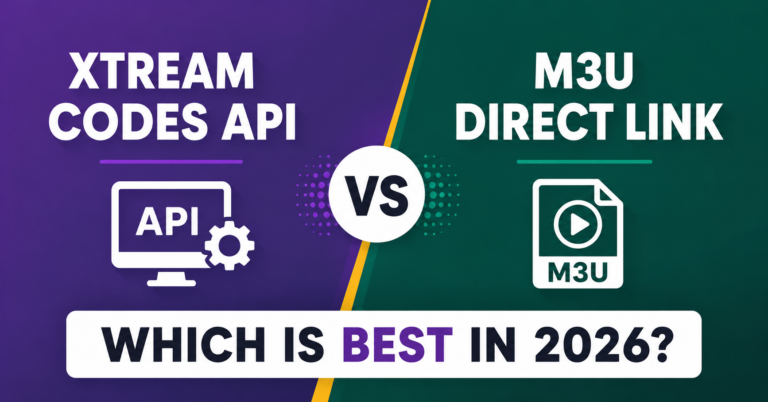
Not all IPTV middleware is built the same. The two dominant architectures in the reseller space are Xtream Codes (and its derivatives) and Stalker Middleware (now often called Ministra). Each handles session management, EPG, and device control differently, and choosing wrong for your operation creates problems that no amount of troubleshooting fixes.
Xtream-based IPTV middleware is what most resellers encounter first. It’s panel-driven, credit-based, and relatively straightforward. Line creation, M3U output, and API-based app authentication all route through a centralised middleware layer. The weakness? Scalability. Xtream-based systems under heavy load tend to bottleneck at the database level — MySQL queries stacking up during peak authentication.
Stalker-based IPTV middleware takes a different approach. It was designed for set-top box environments — MAG devices primarily. Authentication is MAC-based, the portal interface is server-rendered, and the EPG system integrates differently. It handles large device pools well but is less flexible for multi-app, multi-platform reseller operations.
| Feature | Xtream-Based Middleware | Stalker-Based Middleware |
|---|---|---|
| Primary Auth Method | Username/password + API token | MAC address + portal URL |
| Best For | Multi-platform apps (mobile, Smart TV, Fire Stick) | MAG devices, dedicated STBs |
| EPG Handling | XMLTV import, mapped per channel | Built-in portal EPG, less customisable |
| Reseller Panel | Full credit-based sub-reseller system | Limited reseller hierarchy |
| Scalability Ceiling | Database-bound under heavy peak load | Better device pooling, weaker API flexibility |
For most resellers selling to households across multiple device types, Xtream-based IPTV middleware is the practical choice. But if your market is heavily MAG-device oriented, Stalker handles that ecosystem natively with less configuration friction.
Middleware Caching: The Silent Performance Multiplier
Here’s a dimension of IPTV middleware that determines performance more than raw server specs: caching strategy. Every time a subscriber opens the app and loads the channel list, that’s a middleware request. Every EPG render, every VOD catalogue pull, every catch-up query — middleware request. Without aggressive caching, your IPTV middleware is regenerating the same data thousands of times per hour.
Intelligent middleware caching works in layers:
- Channel List Cache — Generated once per update cycle, served as a static response to all subscribers on the same package. No per-request database query.
- EPG Data Cache — Parsed XMLTV stored in memory (Redis or Memcached) rather than re-parsed from XML on each request.
- Authentication Token Cache — Valid tokens cached with TTL so the middleware doesn’t re-query the database for every stream request from an already-authenticated device.
Resellers can’t usually configure caching directly. But you can test for it. Load your channel list, then reload immediately. If the second load is noticeably faster, caching is working. If both loads take the same time, the IPTV middleware is hitting the database cold every single time — and that’s an infrastructure gap your provider needs to address.
Pro Tip: During major live events — cup finals, title deciders — caching is what prevents your IPTV middleware from collapsing. Uncached middleware serving 10,000 simultaneous EPG requests will crater. Cached middleware serves them from memory in milliseconds. Ask your provider about their caching layer before the next big fixture, not during it.
What Happens When You Outgrow Your IPTV Middleware
Scaling is where most reseller operations hit a wall they didn’t see coming. You started with 50 lines, grew to 500, then passed 2,000. The streams are fine. The content is fine. But the IPTV middleware — the layer handling every authentication, every session, every EPG pull — is running on the same infrastructure it used when you had 50 lines.
The symptoms of outgrown middleware are specific:
- Line activations take 8–15 seconds instead of 1–2
- Panel dashboard loads slowly or times out during evening peak
- Subscribers report intermittent “authorization failed” errors despite valid subscriptions
- EPG data appears for some channels but not others, inconsistently across devices
- Catch-up and VOD libraries load partially or not at all
Every one of those points back to the IPTV middleware being resource-starved. The streams themselves bypass middleware once they’re playing — they flow directly from the CDN to the device. But the initiation of every stream, every session check, every piece of metadata depends on middleware headroom.
If you’re approaching a scale where these symptoms appear, the conversation with your provider isn’t about “fixing the server.” It’s about middleware architecture — load-balanced IPTV middleware instances, database read replicas, and whether the middleware can horizontally scale or whether you’ve hit the ceiling of a vertically-scaled single instance.
Frequently Asked Questions
What exactly is IPTV middleware and why should resellers care about it?
IPTV middleware is the software layer that sits between the streaming servers and the end-user application. It manages authentication, EPG delivery, channel list generation, and session control. Resellers should care because middleware performance directly determines subscriber experience — buffering, EPG accuracy, and connection stability all depend on it. A weak middleware layer undermines even the best content library.
Can I change or upgrade the IPTV middleware on my reseller panel?
In most reseller setups, you cannot directly modify the middleware — it’s managed by your upstream provider. However, you can switch providers to one running more robust IPTV middleware infrastructure. Before switching, test the new provider’s panel response times, EPG refresh frequency, and failover behaviour during peak hours to ensure the middleware actually performs better.
How does IPTV middleware affect buffering even when my internet speed is fast?
Buffering during initial channel loading is often caused by the IPTV middleware assigning your stream to an overloaded or geographically distant server node. Your internet speed only matters once the stream reaches your device. The middleware’s server selection logic — whether it uses geo-aware load balancing or simple round-robin — determines the first and most critical link in the chain.
Why does my EPG show incorrect programme times or blank entries?
This almost always traces back to the IPTV middleware layer that parses XMLTV data. If the middleware hasn’t refreshed the EPG source recently, or if channel ID mappings have shifted without a corresponding middleware update, you’ll see stale or mismatched programme guides. The fix sits at the provider level — the middleware needs more frequent EPG refresh cycles and accurate channel ID mapping.
Is Stalker middleware better than Xtream-based middleware for resellers?
Neither is universally better — it depends on your device ecosystem. Stalker-based IPTV middleware excels with MAG set-top boxes and handles large MAC-authenticated device pools efficiently. Xtream-based middleware offers more flexibility for multi-platform operations across mobile, Fire Stick, and Smart TV apps. Most resellers selling to households across mixed devices find Xtream-based systems more practical.
How do ISPs block IPTV middleware in 2026?
Beyond traditional DNS poisoning, ISPs now use SNI filtering and direct API endpoint blocking. They identify the URLs that IPTV middleware uses for authentication and channel list delivery, then block those endpoints at the network level. This means streams might technically be reachable, but subscribers can’t authenticate — effectively disabling the entire service through the middleware layer alone.
How many active lines can typical IPTV middleware handle before performance drops?
There’s no universal number — it depends entirely on the underlying infrastructure. Single-instance IPTV middleware on modest hardware often starts showing strain around 800–1,200 concurrent authenticated sessions. Load-balanced middleware clusters with Redis caching and database read replicas can handle tens of thousands. The key metric to watch is authentication response time during peak hours, not total line count.
Does IPTV middleware work differently on Fire Stick compared to Smart TVs?
The middleware itself operates identically regardless of device — it’s server-side software. However, the app on each device may interact with the IPTV middleware API differently, particularly around device token generation and connection reporting. Fire Stick apps tend to generate new device tokens more frequently after app updates or cache clears, which can trigger false multi-connection alerts in the middleware.
Your IPTV Middleware Checklist: What to Do This Week
This isn’t aspirational. These are concrete steps you can execute before your next billing cycle:
- Audit your middleware response times. Open your panel during peak hours (19:00–22:00 UK time). If line activation takes longer than 4 seconds or the dashboard stalls, document it and raise a ticket with your provider. Specific timestamps strengthen your case.
- Test EPG refresh accuracy. Pick five channels across different categories. Compare the EPG in your app to the actual schedule from the broadcaster’s public listings. If more than one is off by more than 30 minutes, your IPTV middleware EPG parsing needs attention.
- Verify failover behaviour. If possible, temporarily block your provider’s primary middleware API domain at the router level. Does the app switch to a backup endpoint, or does it fail completely? This tells you whether your provider has redundant IPTV middleware infrastructure.
- Check device token behaviour. Connect a Fire Stick via VPN, disconnect, and reconnect with a new VPN server. Log into your panel and check whether the middleware registered that as a new device. If it did, your subscribers are experiencing the same phantom connection issue.
- Assess your scaling headroom. If you’re above 300 active lines and growing, ask your provider directly: is the IPTV middleware load-balanced across multiple instances, or running on a single server? The answer determines whether your next 300 lines will perform like your first 300.
- Bookmark your infrastructure reference. For ongoing guidance on panel management and reseller infrastructure, britishreseller.com IPTV reseller resource hub covers the operational side of these decisions in detail.
The resellers who survive 2026 won’t be the ones with the biggest channel lists. They’ll be the ones who understood that IPTV middleware is the foundation everything else sits on — and built accordingly.