The €2.4 billion question nobody asks until their stream freezes at the 89th minute: why does Bundesliga football break IPTV systems that handle everything else perfectly?
Here’s the short version. Bundesliga streaming IPTV problems are rarely about your subscription quality and almost always about infrastructure timing. German football kicks off in tight, overlapping windows — Saturday’s 15:30 CET block sends six matches live simultaneously, and that synchronised surge is what collapses underbuilt systems. If your Bundesliga streaming IPTV setup buffers during these exact windows but runs fine for a midweek movie, the cause is concurrency load, not your connection. The fix is provider-side redundancy, not endless app reinstalls.
I’ve watched this pattern repeat across enforcement waves since the days when a single source server was considered “good enough.” It isn’t anymore.
What Actually Breaks at 15:30 on a Saturday
Most viewers assume a frozen stream means their internet died. After reviewing thousands of support tickets across UK IPTV reseller networks, I can tell you the timestamp tells the real story. Failures cluster around the German afternoon kickoff slot — the moment when the entire Bundesliga calendar fires at once.
A single-source provider treats those six concurrent matches as one massive demand spike hitting one origin. No load distribution. No second uplink absorbing the overflow. The stream that delivered flawless 4K an hour earlier suddenly stutters because the bottleneck isn’t bandwidth into your home — it’s capacity out of their server.
Pro Tip:
Note the exact minute your Bundesliga streaming IPTV feed degrades for three weekends running. If it’s always inside the 15:25–15:35 window, you’ve diagnosed a provider concurrency problem. No router reset will fix a capacity ceiling you don’t own.
Concurrency Is the Word Cheap Providers Hope You Never Learn
Bandwidth is how much data moves. Concurrency is how many people pull it at the exact same second. German football is a concurrency stress test disguised as entertainment, and it exposes which providers actually invested in infrastructure versus which ones rented one box and prayed.
| Single-Source Setup | Distributed Setup |
|---|---|
| One origin server | Multiple synced origins |
| No failover during spikes | Automatic failover mid-match |
| Saturday block kills quality | Concurrent matches load-balanced |
| Manual recovery (you wait) | Self-healing routing |
| Buffering at peak demand | Stable through kickoff surge |
The right column costs real money to build. That cost is exactly why suspiciously cheap services exist — they’ve simply skipped it, and you discover the omission at the worst possible moment.
Why Geo-Routing Decides Your Stream Quality
Here’s a dimension most guides ignore entirely. Bundesliga broadcast feeds originate in Germany. Every kilometre of unoptimised routing between that origin and your screen adds latency — and latency is what separates a clean live feed from a feed running thirty seconds behind real-time with periodic freezes.
A serious operator uses geo-aware routing: it pulls the German source through optimised paths and CDN nodes rather than bouncing packets across whatever route happens to be cheapest. We once traced a wave of complaints from viewers in three different countries to a single mis-provisioned routing node forcing all German-origin traffic through one congested path. The subscriptions were fine. The geography was broken.
Pro Tip:
If your Bundesliga streaming IPTV feed runs noticeably behind your neighbour’s TV or a friend’s stream, that lag is a routing signature — your provider is pulling the German origin through an inefficient path. Latency this consistent is architectural, not accidental.
The Reseller Side: Where Bundesliga Weekends Make or Break a Panel
If you operate as an IPTV reseller, German match days are your highest-risk hours. This is where the business reality bites, and where most panel owners learn expensive lessons.
A new IPTV reseller signs up customers all week, everything looks healthy, then Saturday’s Bundesliga block hits and the support inbox detonates. The reseller panel didn’t fail at provisioning — it failed at concurrency, because the upstream source behind those panel credits couldn’t absorb a synchronised surge.
What separates resellers who retain customers from those who churn them:
- The panel owner who tests their reseller panel during a live Bundesliga slot, not at 3 AM when nothing is streaming
- The IPTV operator who buys credits from a source with proven multi-uplink redundancy, not the cheapest panel credits available
- The credit reseller who sets honest expectations with sub-resellers about peak-hour load
- The IPTV business owner who treats Saturday 15:30 CET as a stress test, not a coincidence
Pro Tip:
Smart IPTV reseller operators schedule their own quality checks to overlap with the Bundesliga afternoon block. Any panel owner who only tests during dead hours is flying blind into their single highest-traffic window of the week.
A Reseller Mistake We See Every Single Season
One IPTV reseller built a healthy sub-reseller network on a budget upstream source. Cheap panel credits, fat margins, happy customers — through August. Then the Bundesliga season intensified, concurrent match traffic peaked, and the source buckled every Saturday. Sub-resellers blamed the reseller. The reseller blamed the panel. The actual culprit was an infrastructure decision made months earlier to save a few cents per credit.
The lesson every IPTV operator eventually absorbs: an IPTV reseller panel is only ever as reliable as the weakest uplink behind it. You can market beautifully and support attentively, but during a Bundesliga streaming IPTV surge, the infrastructure either holds or it doesn’t.
How to Tell a Real Problem From a You Problem
Before blaming your provider, rule out your own setup. Quick diagnostic checklist:
- Does buffering happen only during the German afternoon kickoff window, or all day?
- Do non-live channels (VOD, movies) play perfectly at the same moment a match freezes?
- Is your device on 5GHz Wi-Fi or wired, not congested 2.4GHz?
- Have you tested a second device on the same connection simultaneously?
- Does the lag appear across multiple Bundesliga matches or just one channel?
If VOD is flawless while live matches freeze at kickoff, the verdict is settled — your hardware is fine, and the concurrency ceiling sits upstream with whoever supplies your Bundesliga streaming IPTV feed.
The 2026 Reality: ISPs Are Watching Match Days Too
There’s a newer layer worth understanding. ISPs increasingly use traffic fingerprinting to identify and throttle large synchronised live-video flows — and few events produce a cleaner fingerprint than a continent’s worth of viewers pulling German football in the same half-hour.
This is why some viewers see degradation that has nothing to do with their provider’s capacity. The provider’s infrastructure is healthy; the ISP is selectively throttling the recognisable pattern. Operators counter this with traffic diversification and varied delivery paths so the flow doesn’t present one obvious signature. It’s an ongoing cat-and-mouse game, and 2026’s blocking is noticeably more sophisticated than the crude IP bans of a few years back.
Pro Tip:
If a VPN dramatically improves your Bundesliga streaming IPTV quality during peak slots, you’re likely facing ISP-level throttling rather than provider capacity limits. A VPN masks the traffic fingerprint — but it also adds a hop, so test both ways before concluding.
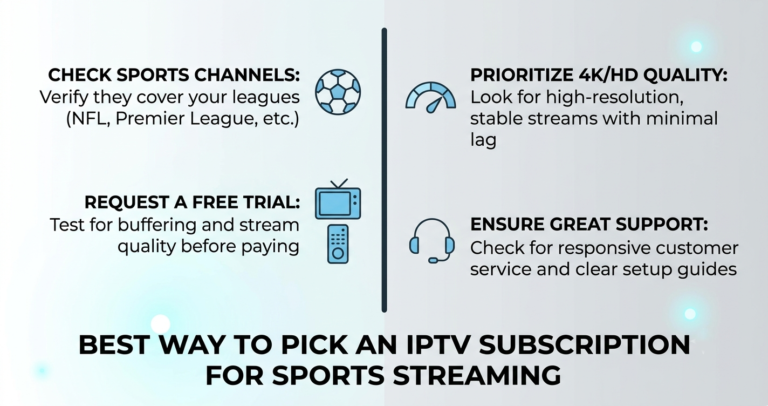
Choosing a Provider That Survives German Football
Reliability during Bundesliga windows comes down to questions most people never think to ask. Whether you’re a subscriber or evaluating an upstream source as an IPTV UK reseller, the criteria overlap. A provider with transparent infrastructure practices and genuine redundancy — the kind detailed by established operators like britishreseller.com — will behave differently at 15:30 CET than a single-box reseller running on hope.
Ask directly: do they run multiple synced sources? Is failover automatic or manual? Have they handled a full Bundesliga Saturday block without incident? Vague answers are an answer.
Frequently Asked Questions
Why does my Bundesliga streaming IPTV buffer only on Saturday afternoons?
Because German football’s main kickoff block sends multiple matches live simultaneously around 15:30 CET, creating a concurrency surge. If your Bundesliga streaming IPTV feed buffers only in that window but runs fine otherwise, the cause is upstream capacity — your provider’s source can’t absorb synchronised peak demand, not your home connection.
Is buffering during Bundesliga matches my internet or my provider’s fault?
Run one test: if VOD and movies play perfectly while live matches freeze at the same moment, your connection is fine. Live-only failure during peak kickoff windows points to provider concurrency limits or ISP throttling of the recognisable live-traffic fingerprint, not your bandwidth.
What makes Bundesliga streaming IPTV harder to deliver than other leagues?
The schedule. Bundesliga concentrates matches into tight, overlapping Saturday windows rather than spreading them out. That synchronisation produces a sharper concurrency spike than leagues with staggered kickoffs, exposing any provider lacking load balancing and multi-source redundancy precisely when viewers are watching.
As an IPTV reseller, how do I avoid Bundesliga-weekend complaints?
Test your reseller panel during an actual live Bundesliga block, not during quiet hours. Source your panel credits from an upstream provider with proven multi-uplink redundancy rather than the cheapest option. Any IPTV operator who only verifies quality at off-peak times is gambling on their highest-traffic window.
Will a VPN fix my Bundesliga streaming freezing?
Sometimes. If the cause is ISP traffic throttling, a VPN masks the fingerprint and improves quality. If the cause is genuine provider capacity, a VPN adds a hop and may worsen it. Test with and without to identify which problem you actually have before committing.
How far behind real-time should a good live feed be?
A well-routed live stream typically runs a handful of seconds behind broadcast. Consistent thirty-second-plus delays or lag noticeably worse than other viewers signal inefficient geo-routing — your provider is pulling the German origin through a congested path rather than an optimised one.
Does paying more guarantee better Bundesliga streaming?
No. Price correlates loosely with infrastructure but doesn’t prove it. Some expensive services still run single-source setups. Ask about synced sources, automatic failover, and documented Saturday-block performance. Verified redundancy matters far more than the number on the invoice.
Action Checklists
For Subscribers:
- Log the exact minute your stream degrades for three consecutive match days
- Test VOD playback during a live freeze to isolate the cause
- Switch to 5GHz Wi-Fi or wired before blaming the provider
- Try a VPN during peak slots to test for ISP throttling
- Ask your provider directly about synced sources and failover
For Resellers:
- Run quality checks during a live Bundesliga block, never only off-peak
- Verify your upstream source’s multi-uplink redundancy before buying panel credits
- Document your panel’s performance across a full Saturday kickoff window
- Set honest peak-hour expectations with every sub-reseller
- Keep a tested backup source ready before the season intensifies
For Sub-Resellers:
- Confirm your panel owner’s source handles concurrent match traffic
- Escalate Saturday-specific complaints to the panel owner, not the customer
- Track which match windows generate the most tickets
- Avoid over-promising stability you can’t verify upstream
The Bottom Line
Bundesliga streaming IPTV doesn’t fail randomly — it fails on a schedule, in a window, for reasons that trace back to infrastructure decisions made long before kickoff. Once you understand that the 15:30 CET concurrency surge is the real test, both diagnosing your own issues and choosing a provider become far simpler. Bundesliga streaming IPTV reliability is bought at the infrastructure layer, not the marketing one.
The single most useful habit you can build: stop treating a Saturday freeze as bad luck and start reading it as data. The timestamp, the VOD comparison, and the lag signature will tell you exactly where the problem lives — and that knowledge is what turns a frustrated subscriber or a churning reseller into someone who picks the right infrastructure the first time.