Best IPTV for World Cup 2026 Live Streaming
Here’s something that catches people off guard every four years: the service that streamed the regular season flawlessly is often the same one that collapses on opening night of a major tournament: same panel, same provider, same app. The difference isn’t the software. It’s that fifty thousand people decided to watch the same match at the same second, and the infrastructure underneath was never built for that spike.
So if you’re hunting for the best IPTV for the World Cup 2026, let me give you the short version before anything else.
The quick answer: The best IPTV for World Cup 2026 is not the one with the longest channel list or the cheapest yearly plan. It’s the one whose backend can absorb sudden traffic surges without freezing during the matches that matter. For 104 fixtures spread across the United States, Mexico, and Canada from June 11 to July 19, with kickoffs landing at brutal hours across every English-speaking time zone, what you actually need is a provider with redundant uplinks, real load balancing, and a track record of staying online when everyone else is watching too. Channel count is a footnote. Stability is the whole game.
That’s the part most buying guides skip. They rank services by how many leagues they list. Nobody lists “survived the last three tournament finals without a single freeze,” because that’s the metric you can’t fake with a feature table.
Why does opening night break more services than any other date?
The 2026 tournament kicked off on June 11 when Mexico hosted South Africa at Estadio Azteca. The final lands July 19 at MetLife Stadium in New Jersey. In between sit 104 matches, the most ever, because FIFA expanded the field to 48 teams in 12 groups. More matches mean more simultaneous viewing windows, and that’s where things get ugly for unprepared panels.
During the last big tournament, we watched a mid-sized provider hold steady through forty quiet evenings, then drop offline for nine minutes during a single high-demand kickoff. Their daily traffic was fine. Their peak traffic wasn’t. The load balancer they’d bolted on was theatre, not engineering.
Pro Tip:
Ask any provider directly what their concurrent stream ceiling is per server, and what happens at 90 percent of it. If they don’t have a number, they’ve never measured one, which means they’ve never planned for the night you actually need them.
Sudden demand behaves nothing like steady demand. A server humming along at forty percent capacity can saturate in under a minute when a marquee fixture starts. Once buffering begins, it cascades, because frustrated users hammer the reload button and multiply the load they were already straining against.
The time-zone trap nobody warns you about
This one’s specific to 2026, and it’s the detail that separates a usable service from a frustrating one for viewers outside North America. The matches are scattered across the US Eastern, Central, Mountain, and Pacific zones, plus Mexican and Canadian venues. For a fan in the UK, East Coast kickoffs run five hours behind BST, Central venues six hours behind. Late matches mean very late nights, and very late nights mean your provider’s overnight maintenance windows suddenly overlap with peak viewing.
A UK IPTV reseller I know got buried in tickets last cycle for exactly this reason. His upstream source ran scheduled maintenance at 2 am their time, historically dead hours. During the tournament, those dead hours were prime time for half his customer base. He hadn’t checked. The lesson stuck.
Steady season service, Tournament-ready service
Single upstream source Multiple independent sources
Maintenance on a fixed clock. Maintenance paused during events
No concurrent stream ceiling published. Known, tested capacity limits
One geographic route, Geo routing with failover
Reactive monitoring, Active monitoring with alerts
What “best” actually means for a paying subscriber
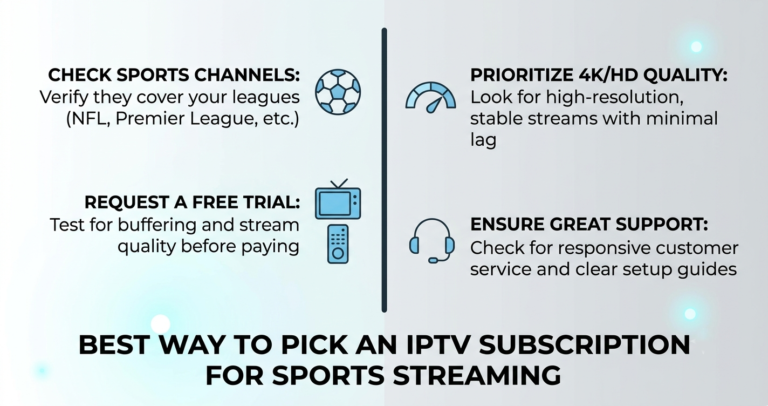
If you’re a viewer rather than a seller, here’s how to test a service before you commit money to it for the tournament. Don’t trust the trial during a quiet Tuesday afternoon. That tells you nothing. Test it during any live high-demand event you can find and watch what happens in the first ninety seconds of a popular match.
Watch for these signals:
- Does the stream load within a few seconds, or does it spin?
- Does picture quality hold during the busiest minute, or drop to a blurry mess?
- Does the channel recover quickly after a brief freeze, or stay frozen?
- Is there a backup feed for the same match if one source fails?
Pro Tip:
The single most useful question to a subscriber is: “If this exact channel freezes during the final, is there a second feed I can switch to instantly?” A real answer means real redundancy. A vague answer means you’ll be staring at a buffering wheel at the worst possible moment.
A service can look perfect for weeks and still be the wrong choice for tournament season, because tournament season tests a dimension that ordinary use never touches.
How resellers either profit or get buried during a World Cup
This is where the conversation shifts, because a tournament is the single biggest opportunity and the single biggest risk in the reseller calendar. Demand spikes. New customers flood in. Trial requests pour through the panel. And if the infrastructure underneath buckles, every one of those new sign-ups becomes a refund request and a bad review.
Every experienced IPTV reseller knows the pattern. The weeks before kickoff bring a surge of buyers who’ve never used the service and have zero patience. They judge the entire experience on one match. A panel owner who can’t deliver during that window doesn’t just lose the new customers; they lose the regulars who got caught in the congestion, too.
Here’s the reseller reality in plain terms:
- A credit reseller who oversells capacity before a tournament is gambling with churn
- Trial users acquired during peak demand convert worse, because the service is under its heaviest strain exactly when they’re deciding.
- Support tickets during a major event can spike to several times the normal volume.
- The IPTV reseller panel you build on matters more in one tournament week than in six ordinary months
We’ve seen sub-resellers double their customer base in a fortnight around a major event, then lose most of it within a month because the upstream couldn’t hold. Growth that isn’t backed by infrastructure isn’t growth. It’s a liability with a delay timer.
Pro Tip:
Smart panel owners cap new activations in the days before a major tournament rather than chasing every sale. Protecting service quality for existing customers retains more revenue than a flood of fragile new sign-ups that churn out angry.
The infrastructure questions that separate a real provider from a logo
Whether you’re a subscriber or a reseller sourcing your supply, the technical backbone is what you’re actually buying. You don’t need to be an engineer to ask the right things; you need to know which words mean something.
A few worth understanding in plain English:
Load balancing means traffic gets spread across several servers instead of being concentrated on one. Without it, your single busiest match takes everything down.
Failover means that when one source dies, another takes over automatically, ideally before you notice. Manual failover during a final is no failover at all.
Redundant uplinks mean the provider doesn’t depend on a single internet pipe. One backup uplink is the difference between a five-second blip and a dead evening.
Geo routing sends viewers to the nearest healthy server, which cuts latency. For a tournament spread across North America with a global audience, routing decisions directly shape whether your stream stutters.
Mini case study: A panel owner we worked with switched to a supplier with genuine multi-source redundancy six weeks before a tournament. During the busiest fixture, his primary source failed, exactly the disaster scenario. Failover kicked in within seconds. His customers reported a brief hiccup and nothing more. His competitor on a single-source setup went dark for the entire first half. The two businesses sold nearly identical packages at nearly identical prices. The infrastructure underneath was the only real difference, and it decided who kept their customers.
ISP behaviour during big events has changed
Worth noting for 2026 specifically: ISP throttling and traffic fingerprinting have grown more sophisticated. During high-profile events, some networks now identify and slow streaming traffic patterns more aggressively than they did a few years ago. This isn’t paranoia, it’s something operators observe in their monitoring logs every tournament cycle.
The practical upshot for a viewer is that raw provider quality isn’t the only variable anymore. Your own connection path matters. The best IPTV for the World Cup 2026 from a quality standpoint can still stutter if your ISP is selectively throttling the route. Providers with diversified routing and multiple delivery paths give your traffic more ways to reach you cleanly, which is one more reason infrastructure depth beats a long channel list.
Frequently asked questions
What makes one IPTV service the best IPTV for the World Cup 2026 over another?
It comes down to peak-load behaviour, not features. The best IPTV for the World Cup 2026 is the service that stays stable when thousands of people stream the same match simultaneously. Redundant sources, real load balancing, and tested concurrent capacity matter far more than how many channels appear on a list.
How do I test an IPTV service before the tournament starts?
Don’t test during quiet hours. Watch a live high-demand event and judge the first ninety seconds of a busy match. Check load time, whether picture quality holds at peak, and whether a backup feed exists. Stability under real strain is the only test that predicts tournament performance.
Is the most expensive service automatically the best IPTV for the World Cup 2026?
No. Price often reflects marketing budget, not server quality. Some mid-priced providers run far better infrastructure than premium-branded ones. Judge by demonstrated stability during live events and by whether the provider can answer concrete questions about failover and capacity, not by the sticker.
As an IPTV reseller, how do I prepare my panel for tournament demand?
Don’t oversell. Confirm your upstream supplier has multi-source redundancy and won’t run maintenance during match windows. Consider capping new activations right before kickoff to protect existing customers. A reseller panel built on weak infrastructure turns a demand surge into a churn event rather than a profit window.
Why does my stream freeze only during big matches and not normally?
Because ordinary viewing never tests peak capacity. When a marquee fixture starts, concurrent streams spike, and an under-provisioned server saturates fast. The freeze is a capacity problem, not a device problem. A provider with proper load balancing and failover absorbs that surge without dropping you.
Do I need a different setup for late-night kickoffs?
The matches themselves don’t require special hardware, but be aware that North American venues mean awkward hours for overseas viewers. Confirm your provider doesn’t schedule maintenance during your match windows, and have a backup viewing method ready in case your primary feed has trouble at an unusual hour.
Conclusion
The best IPTV for World Cup 2026 isn’t a brand you can name from a banner ad. It’s a set of infrastructure decisions that only reveal themselves under load. With 104 matches running from June 11 to July 19 across scattered North American time zones, the services that survive will be the ones built for surges, redundant sources, real load balancing, honest capacity limits, and maintenance schedules that respect when people actually watch. Everything else is marketing. If you’re choosing a provider or sourcing one as a UK IPTV reseller, test under strain, ask the concrete questions, and treat a long channel list as the least important number on the page. For a closer look at how tournament-grade infrastructure is built, the team at britishseller.co.uk breaks down what reliable delivery actually requires.
Action checklists
For subscribers
- Test any trial during a live high-demand event, never during quiet hours
- Confirm a backup feed exists for major channels
- Check picture quality during the busiest minute, not the calm ones
- Note your time-zone match windows and confirm the provider isn’t down for maintenance, then
- Have a second viewing option ready for the final
For resellers
- Verify your upstream supplier runs multiple independent sources
- Confirm no scheduled maintenance during match windows
- Cap new activations in the days before kickoff to protect existing customers
- Pre-write support responses for the predictable surge in tickets
- Stress-test your reseller panel at the projected peak before demand arrives
For sub-resellers
- Confirm the panel owner above you has tested failover; don’t assume it
- Don’t promise capacity that your upstream can’t guarantee
- Hold a buffer of panel credits rather than committing everyone before the tournament
- Keep a direct line to your supplier for real-time issues during big matches
- Track which fixtures drive your ticket spikes so you can plan for the next event
A tournament doesn’t create new infrastructure problems. It exposes the ones that were already there, all at once, on the night you can least afford them. Pick your service for the worst sixty seconds of the busiest match, not for the easy Tuesday, and you’ll watch the whole thing in peace.