The Panel Behind the Panel: What Xtream Codes for IPTV Actually Demands in 2026
Most resellers think they understand Xtream Codes for IPTV. They log in, generate lines, distribute credits, and assume everything under the hood is someone else’s problem. That assumption is exactly where businesses collapse.
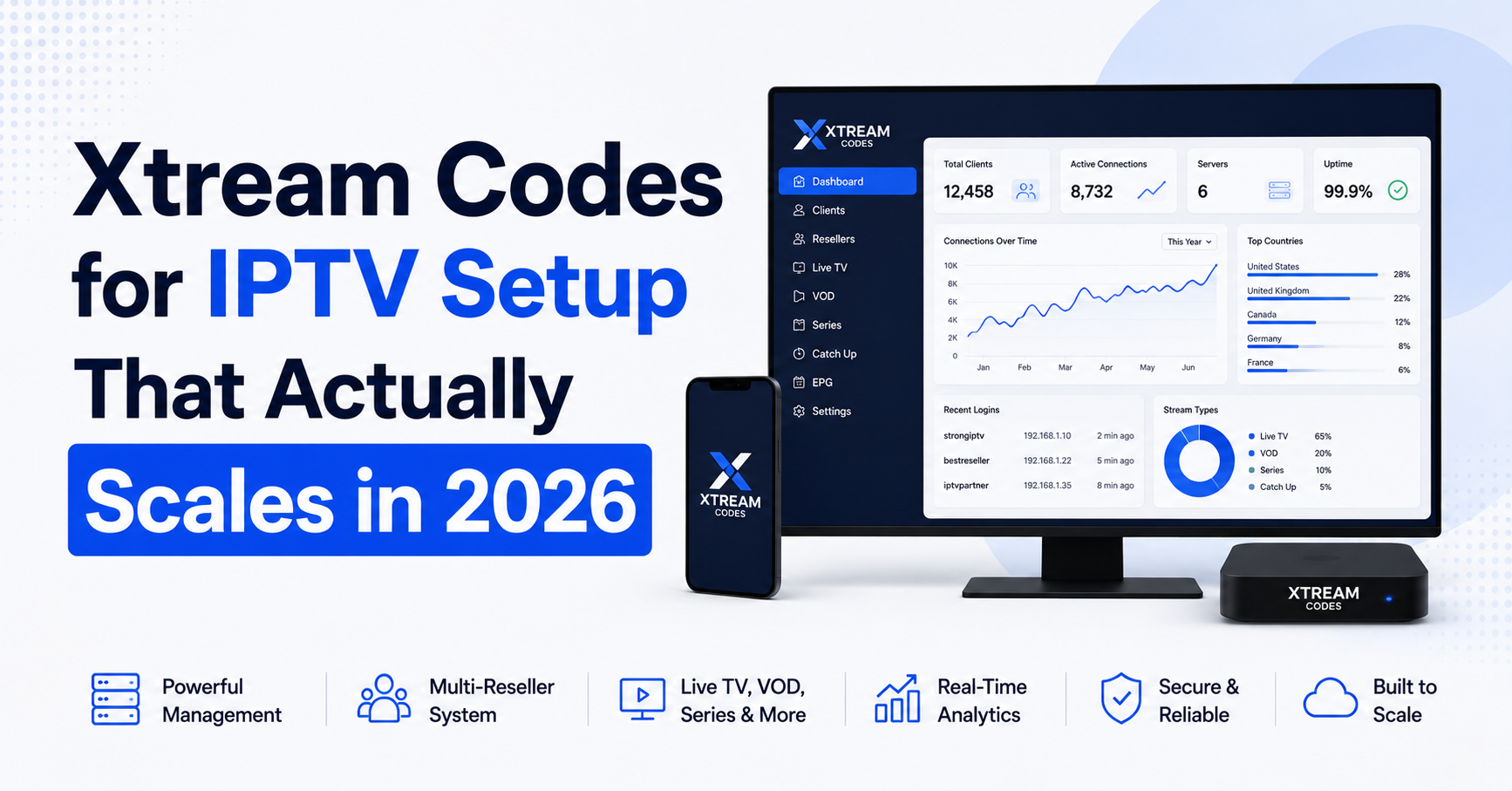
Xtream Codes for IPTV isn’t just a dashboard. It’s a middleware layer that sits between raw stream input and every single end-user connection your network serves. When that middleware misbehaves — or when you’ve misconfigured something you didn’t even know was configurable — your subscribers see buffering. Your resellers see churn. And you see refund requests stacking up at 9pm on a Saturday during a premium football fixture.
This article isn’t a walkthrough of how to click buttons. It’s a breakdown of what separates resellers who survive their first year from those who quietly disappear after three months of escalating complaints.
If you’ve ever wondered why two panels running Xtream Codes for IPTV on seemingly identical infrastructure deliver wildly different user experiences, keep reading. The answer has nothing to do with the streams themselves.
How Xtream Codes for IPTV Processes a Single Stream Request
Before you can fix anything, you need to understand the chain of events that fires every time a subscriber hits “play.”
The request leaves their device, hits your DNS, resolves to your panel’s load balancer (if you have one — most beginners don’t), and then Xtream Codes for IPTV authenticates the line. It checks expiry, max connections, allowed output formats, and the bouquet assignment. Only then does it proxy the stream from the source or redirect to a direct URL.
That entire sequence happens in milliseconds. But each step is a potential failure point.
Pro Tip: The single most overlooked bottleneck isn’t bandwidth — it’s database query time. Xtream Codes for IPTV hammers MySQL on every authentication. If your database isn’t tuned with proper indexing and query caching, you’ll hit walls at 300 concurrent users that no amount of CPU will fix.
The difference between a panel that handles 500 connections smoothly and one that stutters at 200 almost always traces back to database configuration, not server specs.
Why DNS Configuration Breaks More Panels Than Server Failures
Here’s something nobody talks about in UK IPTV reseller forums: DNS poisoning and ISP-level DNS interference cause more viewing interruptions than actual server downtime.
When a major broadband provider decides to block or redirect DNS queries associated with IPTV traffic, every subscriber on that ISP loses access — even though your panel is fully operational. You’ll get flooded with “it’s not working” messages while your dashboard shows zero errors.
Xtream Codes for IPTV lets you configure custom DNS settings per output, but almost nobody uses this properly. Running your panel behind a single DNS entry with no failover is like operating a business with one phone number and no voicemail.
| DNS Approach | Risk Level | Recovery Time |
|---|---|---|
| Single DNS, no failover | Critical | Hours to days |
| Dual DNS with manual switch | Moderate | 30–60 minutes |
| GeoDNS with health checks | Low | Automatic, under 2 minutes |
| DNS over HTTPS with backup uplink servers | Minimal | Near-instant failover |
If you’re running Xtream Codes for IPTV on a serious scale, GeoDNS with automated health checks isn’t optional. It’s baseline.
Panel Credits and the Psychology of Reseller Churn
Technical infrastructure is half the battle. The other half is understanding why your resellers leave — and it’s rarely about stream quality alone.
Xtream Codes for IPTV operates on a credit-based reseller model. You allocate credits, resellers spend them to create subscriber lines, and the cycle continues. Simple enough. But the pricing architecture behind those credits determines whether your reseller network grows or quietly migrates to a competitor overnight.
The most common mistake is flat-rate credit pricing with no volume incentive. A reseller generating 10 lines a month and one generating 200 lines a month pay the same per-credit rate. The high-volume reseller eventually does the maths and realises they could get better margins elsewhere.
Pro Tip: Build three credit tiers directly into your Xtream Codes for IPTV reseller structure — entry, growth, and scale. Weight the discount curve so that resellers crossing the 50-line threshold feel a genuine margin improvement. That psychological inflection point is where loyalty forms.
Churn among resellers isn’t about dissatisfaction with streams. It’s about feeling like the economics don’t reward their effort. Your Xtream Codes for IPTV panel configuration should reflect a pricing model that makes leaving feel expensive.
Load Balancing: The Skill Most IPTV Resellers Never Learn
You’ve got 800 subscribers. Peak time hits. Suddenly, half your users are buffering and the other half are fine. What happened?
In most cases, you’re running Xtream Codes for IPTV on a single main server or a poorly balanced cluster where one node is swallowing 70% of connections while others sit idle. Load balancing inside the Xtream ecosystem isn’t automatic — it requires deliberate configuration of load balancer servers, proper output assignment, and real-time monitoring.
Here’s what a functional load-balanced setup actually looks like in practice:
- Main server handles database, API, and panel interface only — zero stream processing
- Load balancer nodes distributed across at least two geographic regions
- Each node capped at 70% capacity with automatic overflow routing
- Backup uplink servers ready for instant activation if a primary source drops
- HLS latency monitored per-node, not just globally
Most failures in Xtream Codes for IPTV happen because resellers treat the main server as a streaming workhorse. It’s not. It’s a control plane. The moment you push streams through it at scale, you’ve created a single point of failure that will eventually cost you an entire evening’s revenue.
ISP Blocking in 2026: What Changed and What’s Coming
The enforcement landscape shifted dramatically. AI-driven traffic analysis is no longer experimental — major broadband providers across the UK and EU now deploy machine learning models that identify IPTV traffic patterns even through encrypted tunnels.
This matters for anyone running Xtream Codes for IPTV because the old workarounds — simple VPN recommendations, switching ports, rotating domains — are becoming less reliable by the quarter.
What’s actually working in 2026:
- Protocol obfuscation at the server level, not the client level
- Residential proxy routing for authentication handshakes
- Randomised port assignment per subscriber session within Xtream Codes for IPTV
- Domain fronting techniques adapted from CDN architectures
Pro Tip: If your subscribers on a specific broadband provider suddenly report issues while everyone else is fine, don’t troubleshoot the server first. Check ISP-level DNS and DPI (deep packet inspection) reports. Xtream Codes for IPTV might be running perfectly — the block is happening downstream, and your response needs to be a network-level fix, not a panel-level one.
The providers investing in backup uplink servers and redundant stream paths are the ones whose subscribers never even notice an enforcement event happened.
Bouquet Management: Organising 12,000 Channels Without Losing Your Mind
New panel operators using Xtream Codes for IPTV tend to dump every available stream into one or two massive bouquets. It works until it doesn’t.
When a subscriber opens their app and sees 12,000 unsorted channels, they don’t feel impressed. They feel overwhelmed. And overwhelmed subscribers submit more support tickets, complain more often, and ultimately churn faster — even if the stream quality is excellent.
Effective bouquet architecture inside Xtream Codes for IPTV requires thinking like a product designer, not a channel hoarder.
| Bouquet Strategy | Subscriber Experience | Support Load |
|---|---|---|
| Single mega-bouquet | Overwhelming, slow EPG loading | Very high |
| Region-based bouquets | Cleaner, but still broad | Moderate |
| Persona-based (Sports/Family/Movies) | Focused, faster navigation | Low |
| Tiered (Basic/Standard/Premium) | Clear value ladder, upsell path | Minimal |
The persona-based approach works best for household subscribers. Families don’t want to scroll past 400 foreign channels to find children’s content. Resellers targeting the UK family market through Xtream Codes for IPTV should build bouquets that feel curated, not dumped.
HLS Latency and Why Your “HD” Streams Look Terrible
A reseller lists “Full HD” on their sales page. A subscriber pays, connects, and gets a pixelated mess during fast-motion scenes. The streams are technically 1080p. So what went wrong?
HLS latency within Xtream Codes for IPTV creates a cascade effect. When the segment delivery falls behind — even by two or three seconds — the player compensates by dropping quality. The subscriber sees artefacts, stuttering, and resolution drops that look like a bandwidth problem but are actually a timing problem.
The fix isn’t more bandwidth. It’s segment tuning.
- Reduce HLS segment duration from the default (usually 10 seconds) to 4–6 seconds
- Enable chunk transfer encoding on your Xtream Codes for IPTV output settings
- Position load balancer nodes geographically closer to subscriber clusters
- Monitor segment delivery time per channel, not just per server
Pro Tip: Run a latency trace on your top 20 most-watched channels weekly. In Xtream Codes for IPTV, stream issues concentrate on popular channels during peak hours. Fixing those 20 channels improves perceived quality for 80% of your subscriber base.
Subscribers don’t understand HLS segments. They understand “it looks bad.” Your job is to make sure it never reaches that point.
Scaling From 500 to 5,000 Subscribers Without Rebuilding Everything
The transition from a small reseller operation to a mid-scale IPTV business is where most Xtream Codes for IPTV setups collapse. The architecture that worked for 500 connections physically cannot support 5,000 — and the warning signs are subtle until they aren’t.
At 500 subscribers, a single powerful server with a decent connection feels smooth. At 1,500, peak times start showing strain. By 3,000, you’re firefighting every evening. At 5,000, you’re either properly clustered or you’re losing subscribers daily.
The scaling path that actually works:
- Phase 1 (0–500): Single server, focus on stream quality and support
- Phase 2 (500–1,500): Add a dedicated database server, separate panel from streaming
- Phase 3 (1,500–3,000): Deploy two load balancer nodes with regional distribution
- Phase 4 (3,000–5,000): Full cluster with automated failover, backup uplink servers, and dedicated monitoring
Each phase requires Xtream Codes for IPTV reconfiguration. The panel settings that were optimal at Phase 1 will actively harm performance at Phase 3. This is why so many resellers hit a ceiling they can’t diagnose — they scaled hardware but never reconfigured the software layer.
The Backup Uplink Server Strategy Nobody Implements (Until It’s Too Late)
Your primary stream source goes down during a major sporting event. Every subscriber is staring at a black screen. Your Xtream Codes for IPTV panel shows the channels as active because the panel itself is fine — the upstream source is the problem.
This scenario happens more frequently than anyone admits. And the resellers who survive it are the ones who configured backup uplink servers before the crisis, not during it.
Xtream Codes for IPTV supports multiple stream origins per channel. You can assign a primary and secondary (even tertiary) source for every stream. The system will automatically switch when the primary fails — but only if you’ve set it up in advance.
Pro Tip: Don’t just assign backup uplinks — test them monthly. A backup source that’s technically configured but hasn’t been validated in weeks might itself be dead when you need it. Schedule a manual failover test for your top 50 channels every month.
The cost of maintaining a backup uplink server relationship is a fraction of the revenue you lose from a single peak-time outage. Yet most operators running Xtream Codes for IPTV treat backup sources as optional. They’re not. They’re insurance.
Frequently Asked Questions
What exactly does Xtream Codes for IPTV do that a basic playlist can’t?
Xtream Codes for IPTV acts as a full middleware platform — it handles user authentication, connection limits, bouquet assignment, reseller credit management, and stream proxying. A basic M3U playlist is just a static list of URLs with no control over who accesses what, no expiry management, and no multi-tier reseller structure. The panel gives operators granular control that playlists fundamentally cannot provide.
How many concurrent connections can Xtream Codes for IPTV handle on a single server?
It depends entirely on server specifications and configuration, but a well-tuned single server typically caps out at 500–800 concurrent streams before MySQL bottlenecks appear. Beyond that, you need database separation and dedicated load balancer nodes. Operators who push past 800 on one machine without clustering are gambling with peak-time stability.
Is Xtream Codes for IPTV still safe to use in 2026 given ISP enforcement?
The platform itself isn’t the enforcement target — traffic patterns are. Running Xtream Codes for IPTV behind proper DNS failover, protocol obfuscation, and encrypted delivery paths significantly reduces exposure. The operators facing blocks are typically those running default configurations with no network-level protection.
Can I migrate my existing subscriber lines to a new server without downtime?
Yes, Xtream Codes for IPTV supports database export and import. The key is pre-configuring the destination server identically — same bouquet structure, same output formats, same reseller hierarchy. Most migration failures happen because operators change settings during the move. Keep everything identical first, then optimise after confirming stability.
Why do my subscribers experience buffering even though my server CPU usage is low?
Low CPU doesn’t mean healthy performance. In Xtream Codes for IPTV, buffering most commonly stems from MySQL query delays, HLS segment timing issues, or upstream source instability — none of which show up in CPU metrics. Monitor database query time, segment delivery latency, and source uptime separately.
How should I structure credit pricing to retain high-volume resellers?
Build at least three pricing tiers with meaningful margin improvements at each threshold. A reseller creating 50+ lines monthly should feel a noticeable per-credit discount compared to someone creating 10. Xtream Codes for IPTV doesn’t automate tiered pricing natively, so you’ll need to manage this through manual credit allocation or external billing tools.
What’s the best way to handle a mass ISP block affecting half my subscriber base?
Immediately deploy an alternative DNS entry and push updated connection details to affected subscribers. Long-term, configure GeoDNS with automatic health checks within your Xtream Codes for IPTV setup so future blocks trigger automatic rerouting without manual intervention or subscriber-facing disruption.
Does Xtream Codes for IPTV support catch-up TV and VOD alongside live channels?
Yes, it natively supports VOD libraries and catch-up TV functionality. However, VOD content requires separate storage and bandwidth planning — many operators underestimate the disk I/O demands. Dedicate a separate storage-optimised server for VOD if your library exceeds 2,000 titles to avoid impacting live stream performance.
Your Xtream Codes for IPTV Reseller Execution Checklist
- Audit your MySQL configuration — enable query caching and verify indexing on the user authentication table before adding another subscriber
- Separate your main panel server from stream processing immediately if you’re past 300 concurrent users
- Configure at least two DNS entries with health-check failover for every active domain
- Set up backup uplink servers for your 50 most-watched channels and test failover monthly
- Build three reseller credit tiers with escalating volume discounts — price the jump from tier 1 to tier 2 at the 50-line mark
- Restructure bouquets into persona-based categories (Sports, Family, Movies, Entertainment) rather than region-only sorting
- Reduce HLS segment duration to 4–6 seconds and monitor segment delivery latency weekly on peak channels
- Deploy protocol obfuscation at the server level — stop relying on subscriber-side VPNs as your only ISP block defence
- Plan your next infrastructure phase now, not when peak-time complaints force your hand
- Visit britishseller.co.uk to explore a IPTV UK reseller panel built around the scaling principles covered in this guide