The Infrastructure Most UK Resellers Never Bother to Understand
Most people entering the IPTV reseller space in the UK focus obsessively on price per credit and ignore the one thing that will end their business overnight, UK IPTV Architecture. Not the panel. Not the margins. The actual skeleton underneath the service that either holds during a Saturday evening Premier League match or collapses under 300 concurrent streams and takes your entire customer base with it.
This isn’t theory. This is the operational reality that separates resellers still running in 2026 from those who disappeared after their first enforcement wave.
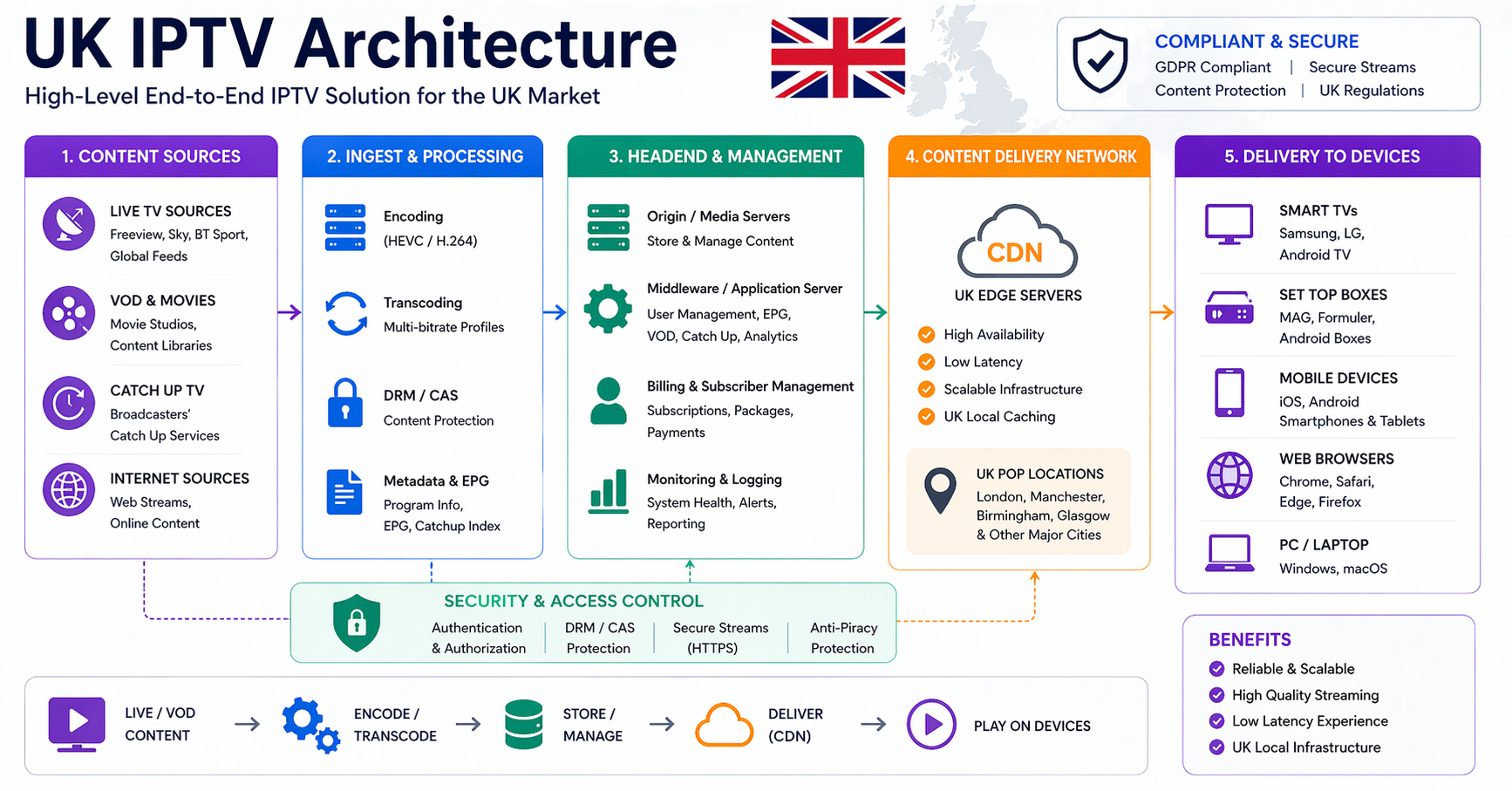
UK IPTV Architecture refers to the entire delivery chain, from the origin server encoding the stream, through content delivery networks, to the HLS packet landing on your customer’s Firestick. Every single node in that chain can fail, and in the UK market specifically, with aggressive ISP-level DNS poisoning now automated at machine speed, the weakest point in your UK IPTV Architecture will be found and exploited faster than you can raise a support ticket.
Understanding this isn’t optional anymore. It’s the entry requirement for running a sustainable reseller operation.
Why UK Streaming Infrastructure Fails at Peak Load, and Who’s Actually Responsible
Here’s what nobody in a reseller Telegram group will tell you: when streams buffer during peak hours, it is almost never a content issue. It’s a load distribution failure inside the UK IPTV Architecture stack.
The most common failure scenario looks like this. A provider oversells capacity on a single upstream server. Fifty UK IPTV resellers, each with 200 customers, all pointing at the same origin. Saturday at 7pm hits. Concurrent sessions spike. HLS latency climbs. Customers start getting the spinning wheel. Tickets flood in. The provider blames “high demand.” Your customer blames you.
What good UK IPTV Architecture actually prevents:
- Single points of failure at the origin encoding layer
- Unbalanced load distribution across CDN edge nodes
- No automatic failover when a node degrades, not just goes down, but degrades
- DNS routing that doesn’t account for regional ISP blocking patterns in the UK
- Providers who share uplink bandwidth across reseller tiers without segregation
Pro Tip: When evaluating a provider, don’t ask “what’s your uptime?” Ask “how many concurrent streams per uplink server, and what triggers your automatic failover?” The answer will tell you everything about their UK IPTV Architecture maturity.
The 2026 ISP Blocking Reality and What It Does to Your Streams
AI-driven enforcement has fundamentally changed the threat model for UK IPTV Architecture. In 2026, major broadcasters are working with ISPs to deploy machine-learning systems that identify IPTV stream patterns at the packet level, not just blocking known IP ranges, but fingerprinting HLS segment requests in real time.
What this means practically:
| Threat Type | Old Method (Pre-2025) | 2026 AI-Driven Method |
|---|---|---|
| IP Blocking | Blacklist known server IPs | Dynamic IP rotation detection |
| DNS Poisoning | Block domain resolvers | Real-time DNS pattern analysis |
| Port Blocking | Block common IPTV ports | Deep packet inspection on all ports |
| CDN Detection | Block CDN hostnames | Behavioural traffic fingerprinting |
Any UK IPTV Architecture that still relies on static IP delivery without SNI rotation, DNS-over-HTTPS fallbacks, or CDN obfuscation is essentially running with an open door in 2026. The providers who have survived the enforcement waves are the ones who architected around this years ago.
Platforms like Autven, referenced by BritishSeller.co.uk, approach UK IPTV Architecture with multi-server failover built in from day one, meaning when an IP range gets poisoned, traffic reroutes before your customers notice anything.
Backup Uplink Servers: The Component Your Provider Probably Skimped On
Single-uplink UK IPTV Architecture is not architecture. It’s a single point of catastrophic failure with a monthly fee attached.
A properly structured UK IPTV Architecture includes at minimum three upstream delivery paths:
Tier 1: Primary high-bandwidth fiber uplink (dedicated, not shared)
Tier 2: Secondary CDN-routed fallback with independent peering
Tier 3: Emergency low-latency backup with regional UK PoP (Point of Presence)
The failover logic matters enormously here. Automatic switching in under three seconds means customers on most devices won’t even see a buffering event. Anything longer, and you start getting support tickets. Anything over ten seconds and customers assume the service is down and call for refunds.
Pro Tip: Ask your provider how they handle partial uplink degradation, not full outages, but when upstream bandwidth drops by 40%. Providers without real monitoring infrastructure will have no answer. That silence tells you everything about the UK IPTV Architecture they’re actually running.
Panel Credits, Subscription Management and What Churn Actually Costs You
Most resellers underestimate churn because they only count lost customers. They don’t count the acquisition cost of replacing them.
In a typical UK IPTV reseller model at the BritishSeller.co.uk tier, where credits run at competitive per-unit rates, a single customer churning after one month represents not just lost recurring revenue, but also the time and marketing cost of finding a replacement. At scale, even a 15% monthly churn rate on 100 customers becomes a treadmill where you’re constantly replacing one in seven customers every 30 days.
The infrastructure link to churn:
| Infrastructure Issue | Customer Impact |
|---|---|
| Buffering during premium sports events | Immediate cancellation requests |
| Panel downtime during renewals | Customers assuming service ended |
| Slow credential delivery after renewal | Trust erosion |
| No EPG accuracy | Customers perceive the service as broken |
That’s exactly why UK IPTV Architecture and business sustainability are inseparable. The technical decisions made upstream determine the customer experience downstream, which directly determines your monthly churn rate.
Panel Management Discipline That Separates Operators from Hobbyists
Running credits through a reseller panel sounds simple. Activate a line, collect payment, renew monthly. But at 50+ active customers, panel management becomes a genuine operational discipline within your UK IPTV Architecture workflow.
- Track expiry dates with at minimum 5-day advance renewal windows
- Never let lines expire during high-traffic periods (weekends, major events)
- Maintain a credit buffer, and never operate at zero reserve
- Document device types per customer (Firestick vs Smart TV vs mobile behaves differently)
- Keep a private log of customers who have complained, since they churn first at the next disruption
Pro Tip: The resellers who scale past 200 customers without chaos are the ones who treat their panel like a CRM, not a credit counter. Your UK IPTV Architecture management is only as strong as the discipline you apply to the panel layer sitting above it.
Read More: IPTV Reseller Panels
Scaling Your UK Streaming Infrastructure: What Changes at 50, 150, and 500 Customers
This is the tier breakdown nobody writes about honestly.
At 50 customers: Your provider’s infrastructure is mostly invisible. Occasional buffering gets blamed on the customer’s internet, and you can manage everything manually. Mistakes are recoverable.
At 150 customers: Peak-hour failures become statistically inevitable on weak UK IPTV Architecture. You’ll start seeing patterns, same time, same channels, same complaints. This is where providers without proper load balancing expose themselves. You now need monitoring, not just customer service.
At 500 customers: You are dependent on the structural integrity of the UK IPTV Architecture your provider runs. Every engineering decision they made two years ago now affects your daily operations. Providers with multi-server failover, CDN-distributed delivery, and active ISP workarounds keep your business running. Providers without these collapse under the load.
The scalability ceiling of your operation is set by the UK IPTV Architecture of your upstream provider, not your sales ability or marketing budget.
Reseller Success Checklist: UK IPTV Architecture Edition
Before you activate your next customer or buy your next credit pack, run through this:
- Confirm your provider runs minimum 3 backup servers with sub-3-second failover
- Verify DNS poisoning mitigation is active (ask directly, demand a real answer)
- Test stream stability during a live sports event before selling to customers
- Ensure your panel credits have no expiry pressure that forces bad timing decisions
- Maintain a 15-credit minimum buffer reserve at all times
- Document your UK IPTV Architecture provider’s uplink configuration (fiber vs shared)
- Set renewal reminders 5 days before every customer expiry
- Know your provider’s escalation path for infrastructure issues, not just a WhatsApp group
- Evaluate EPG accuracy on UK channels specifically, not just global averages
- Understand whether your provider’s UK IPTV Architecture uses regional UK PoPs or routes internationally
The resellers still operating profitably in 2026 aren’t luckier than the ones who failed. They chose the right UK IPTV Architecture from the start and managed it with the discipline of a business operator, not a side hustle.
UK IPTV Architecture is the foundation. Everything else, pricing, marketing, customer service, is built on top of it. Get the foundation wrong, and nothing else matters.