Ghost IPTV: What Operators Know That You Don’t
Most people stumble into IPTV reselling after watching a YouTube tutorial. They grab the cheapest panel, load it with credits, and expect money to start rolling in. Three weeks later, half their subscribers have left. Buffering complaints pile up. Channels vanish overnight. The dream collapses before the first invoice gets paid.
Ghost IPTV exists in a different league. It isn’t a service you throw at a customer and hope for the best. It’s infrastructure built by people who understand what happens when 5,000 concurrent connections hit a server cluster at 8pm on a Saturday during a major sporting event. If you’ve never operated at that scale, the difference between Ghost IPTV and a budget panel won’t be obvious from a features page. It becomes obvious the first night your subscribers don’t complain.
This article isn’t a sales pitch. It’s a breakdown of how Ghost IPTV functions at a technical and commercial level, written for resellers who’ve already been burned once and aren’t willing to repeat the lesson.
The Real Reason Resellers Churn Subscribers Every Month
Nobody talks about churn in IPTV honestly. The industry average for subscriber loss sits somewhere around 30–40% monthly on budget services. That’s catastrophic. You’re spending money acquiring customers who leave before they’ve even paid off the acquisition cost.
Ghost IPTV addresses this at the root. Churn isn’t a marketing problem. It’s a reliability problem dressed up in excuses. When a subscriber’s stream freezes during a live match, they don’t open a support ticket. They open a browser and search for someone else.
The architecture behind Ghost IPTV uses multiple uplink servers with automated failover. That means when one feed source degrades, the system reroutes before the subscriber notices a stutter. Cheap providers run a single uplink. One failure cascades across every reseller and every subscriber on the platform.
Pro Tip: Ask any provider how many uplink sources they maintain per channel category. If they can’t answer that question, they don’t control their own infrastructure. Ghost IPTV maintains redundant feeds across premium sports, entertainment, and international categories independently.
Ghost IPTV Panel Credit Economics That Actually Make Sense
Credits are the currency of reselling, and most newcomers misunderstand how the margin model works. You buy credits in bulk, assign them to subscriber accounts, and the spread between your wholesale cost and retail price is your margin.
Here’s where Ghost IPTV separates from the pack. Their credit tiers are structured so that margin improves as volume increases — but not in the lazy linear way you see elsewhere. The jump between mid-tier and bulk pricing on Ghost IPTV is significant enough that it rewards operators who commit to scaling, rather than hobbyists who activate five accounts a month.
- Entry tier (1–50 credits): Thin margin, suitable for testing the service before committing real capital
- Growth tier (51–200 credits): Margin widens by approximately 15–20%, enough to fund basic advertising
- Scale tier (200+ credits): This is where Ghost IPTV becomes genuinely profitable — margins support paid acquisition, customer support hires, and reinvestment into sub-reseller recruitment
The mistake most resellers make is staying at entry tier for months because they’re “being cautious.” Caution is sensible, but operating at thin margins indefinitely means you can’t absorb a single refund without going negative. Ghost IPTV’s pricing model actually penalises hesitation and rewards operators who treat this as a business rather than a side hobby.
How ISP-Level Blocking Changed Everything in 2026
Let’s talk about the elephant nobody in the reselling community addresses properly. ISP blocking has evolved. In 2024, most blocks were DNS-based. Simple to circumvent. Change your DNS to a third-party resolver, and you were back in business.
2026 is different. AI-driven deep packet inspection now identifies IPTV traffic patterns regardless of DNS configuration. Major UK internet providers have deployed machine learning models that recognise HLS and MPEG-TS stream signatures. DNS poisoning is no longer the primary weapon — behavioural analysis is.
Ghost IPTV has adapted to this shift faster than most providers. Their delivery infrastructure rotates server IPs on dynamic schedules, and the stream packaging uses obfuscation techniques that make traffic appear as standard HTTPS browsing to inspection tools.
| Blocking Method | Budget Providers | Ghost IPTV |
|---|---|---|
| DNS Poisoning | Vulnerable — relies on user to change DNS | Managed — internal DNS routing |
| Deep Packet Inspection | No mitigation — streams easily flagged | Traffic obfuscation + rotating endpoints |
| IP Blacklisting | Static IPs get banned quickly | Dynamic IP rotation across CDN nodes |
| Behavioural Analysis | No awareness of this threat | Stream packaging mimics standard HTTPS |
Pro Tip: If your provider’s servers use the same IP blocks for more than 48 hours, they’ll end up on every major ISP’s blocklist. Ghost IPTV’s rotation schedule is measured in hours, not days.
Building a Sub-Reseller Network on Ghost IPTV Without Cannibalising Your Own Sales
Sub-reselling is the fastest path to passive income in IPTV — if the panel supports it properly. Most panels offer basic sub-reseller functionality, but the controls are shallow. You can create accounts, sure. But can you control pricing floors? Can you restrict which packages your sub-resellers offer? Can you prevent them from undercutting you in the same geographic market?
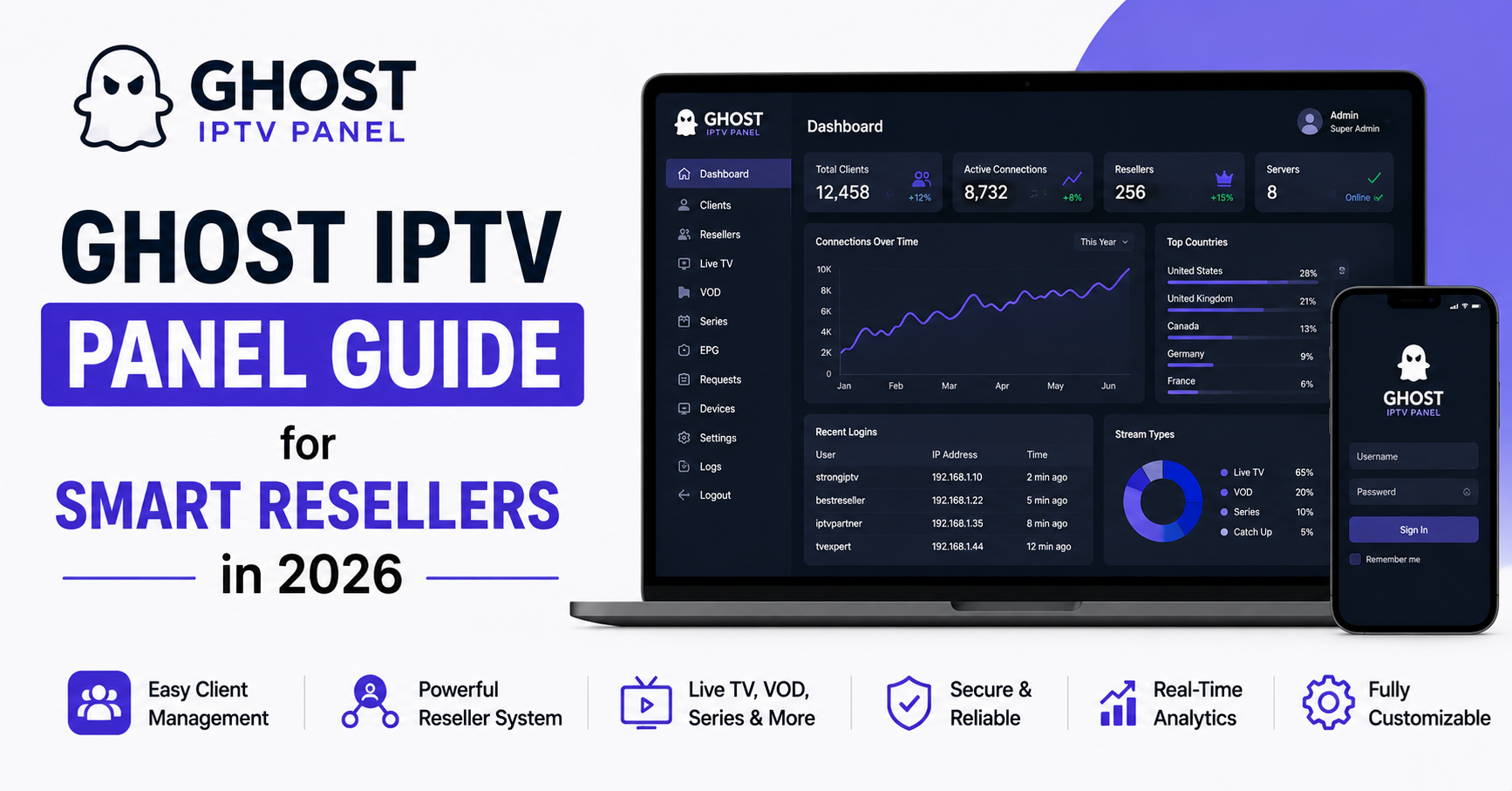
Ghost IPTV’s panel gives you granular control over sub-reseller permissions. You define minimum pricing. You assign package visibility. You control which bouquets a sub-reseller can even see, let alone sell.
This matters because the single fastest way to destroy a reselling business is to recruit sub-resellers who then compete with you on price in the same Facebook groups and forums you’re advertising in. Without pricing floors, your own recruits become your competitors.
- Set minimum retail prices for each subscription duration (1-month, 3-month, 6-month, 12-month)
- Restrict premium sports packages to your own direct sales while offering entertainment-only bundles to sub-resellers
- Monitor sub-reseller activation rates to identify who’s actually selling and who’s sitting on credits
Ghost IPTV’s panel dashboard tracks all of this. The operators who scale past 500 subscribers almost always have a sub-reseller layer beneath them, but it’s a controlled layer, not a free-for-all.
Load Balancing: Why Your Saturday Night Streams Keep Dying
Picture this. It’s a Saturday evening. Two major football matches are kicking off simultaneously. Every subscriber on your panel is online. Concurrent connections spike from 200 to 1,800 in fifteen minutes.
On a poorly balanced system, the server buckles. Buffering spirals. Channels drop to lower resolution or die completely. Your phone starts buzzing with complaints. You send a message to your provider’s support group. They say “we’re working on it.” Two hours later, the matches are over. The damage is done.
Ghost IPTV uses load balancing across geographically distributed server clusters. When a node approaches capacity, connections redistribute automatically. Subscribers don’t experience this — they just see uninterrupted streams. The engineering happens invisibly, which is exactly how it should work.
Pro Tip: Test your provider on a major event night BEFORE committing to bulk credits. Activate a trial. Watch a premium sports stream during peak hours. If it buffers during the trial, imagine what happens when you’ve sold 300 subscriptions and your reputation is on the line. Ghost IPTV actively encourages this test because their infrastructure holds up under pressure.
The VOD Library Nobody Talks About
Live channels dominate the conversation around IPTV, but the VOD catalogue is what keeps subscribers between events. A household that only watches live football three times a week still wants something to watch on Tuesday evening. If your service has a weak VOD library, subscribers start using competing streaming platforms — and eventually they question why they’re paying you at all.
Ghost IPTV maintains a VOD library that updates daily. New releases, classic films, box sets, documentaries, kids’ content. The library is categorised cleanly — not dumped into one alphabetical list like some providers still do in 2026, inexplicably.
For resellers, VOD is a retention tool. It doesn’t drive new sales the way live sport does, but it prevents cancellations. The cost of keeping a subscriber is always lower than acquiring a new one, and Ghost IPTV’s content depth serves that retention play perfectly.
- VOD content sorted by genre, release year, and language
- Series organised by season and episode with proper metadata
- Kids section separated for family-friendly browsing
- Regular library audits remove dead links and broken files
That last point matters more than you’d think. Nothing screams “amateur operation” like a VOD library full of titles that don’t play. Ghost IPTV runs automated checks that flag and remove broken content before your subscribers discover it.
Ghost IPTV on Every Device: Why Compatibility Isn’t Optional
A subscriber who can’t get the service running on their device is a lost subscriber. Full stop. It doesn’t matter how good the streams are if the person can’t watch them on the hardware they already own.
Ghost IPTV supports M3U, Xtream Codes API, and MAG portal connections. That covers virtually every IPTV player on the market. TiviMate, IPTV Smarters Pro, OttNavigator, STB Emulator, VLC — all work without custom configuration beyond entering the standard credentials.
For resellers, this means fewer support tickets. You’re not troubleshooting obscure connection formats or telling customers their device isn’t compatible. Ghost IPTV’s connection versatility means the setup instructions you write once work for 95% of your subscriber base.
Pro Tip: Create a simple one-page setup guide for the three most common players (TiviMate, Smarters Pro, and the native Smart TV app). Pin it in your customer support channel. This single document eliminates roughly 60% of “how do I set it up” messages and lets you focus on actual issues.
Risk Management for Ghost IPTV Resellers
Reselling IPTV isn’t without risk, and pretending otherwise is dishonest. Server seizures happen. Payment processors freeze accounts. Provider owners disappear. These aren’t hypotheticals — every experienced operator has a story.
Smart Ghost IPTV resellers mitigate this by never putting all their capital into credits at once. Buy what you need for the next 30–60 days. Keep cash reserves. Maintain a backup provider relationship — not because Ghost IPTV is likely to disappear, but because diversification is standard business practice in any industry with external risk factors.
- Never invest more than 60% of working capital in credits at any single time
- Maintain a tested backup provider you can migrate subscribers to within 24 hours
- Keep subscriber records (usernames, expiry dates, package types) in your own spreadsheet — not only in the panel
- Use a payment method that offers buyer protection for wholesale credit purchases
Ghost IPTV’s reliability reduces the likelihood of needing these contingencies, but the resellers who survive long-term are the ones who plan for disruption rather than assuming it won’t happen.
HLS Latency and Why Your Subscribers Think the Stream Is “Lagging”
Here’s a complaint every reseller has heard: “The stream is lagging behind my mate’s.” The subscriber thinks something is broken. What’s actually happening is HLS latency — the inherent delay in HTTP Live Streaming protocol.
Standard HLS operates with a 15–30 second delay from the live broadcast. That’s normal. It’s a consequence of how the stream gets segmented, encoded, and delivered through CDN nodes. Ghost IPTV optimises this with reduced segment sizes and aggressive caching, bringing typical latency down to 8–12 seconds. Still not real-time, but close enough that the gap between your subscriber and someone watching via a traditional aerial becomes barely noticeable.
The key for resellers is managing expectations. Educate your subscribers upfront that a small delay exists on all IPTV services. The ones who know this in advance never complain. The ones who don’t know assume the service is faulty.
| Latency Factor | Standard HLS | Ghost IPTV Optimised |
|---|---|---|
| Segment Duration | 6–10 seconds | 2–4 seconds |
| Buffer Depth | 3 segments (18–30s delay) | 2 segments (4–8s delay) |
| CDN Hop Count | 3–5 hops | 1–2 hops via edge caching |
| Typical Live Delay | 20–35 seconds | 8–12 seconds |
The Quiet Advantage: Ghost IPTV’s EPG and Channel Organisation
An underrated selling point. The Electronic Programme Guide on Ghost IPTV is properly structured. Channels are grouped by country, category, and genre. The EPG data loads quickly, displays accurate scheduling, and doesn’t crash the player — which, if you’ve used budget services, you know is not guaranteed.
For household subscribers, the EPG is the interface. It’s what they interact with when deciding what to watch. A messy, slow, or inaccurate guide makes the entire service feel broken even when the streams themselves are perfect.
Ghost IPTV’s channel organisation follows logical groupings that match how people actually browse. UK entertainment, UK sports, UK news, then international categories. Not a random jumble of 15,000 channels with no structure, which is what some providers consider acceptable.
Pro Tip: When onboarding new subscribers, walk them through the EPG briefly. Show them how channels are grouped, how to set favourites, and how to use the search function in their player. Five minutes of orientation reduces “I can’t find the channel” messages by 80%. Ghost IPTV’s clean structure makes this walkthrough fast and painless.
Frequently Asked Questions
What makes Ghost IPTV different from other reseller panels?
Ghost IPTV uses redundant uplink servers with automated failover, dynamic IP rotation, and HLS latency optimisation that most budget panels lack entirely. The credit pricing structure also rewards scaling with meaningful margin jumps rather than marginal discounts. These infrastructure decisions directly reduce subscriber churn and improve reseller profitability over time.
Can I run Ghost IPTV on a Firestick or Android box?
Yes. Ghost IPTV supports Xtream Codes API, M3U, and MAG portal formats, making it compatible with virtually every IPTV player available on Firestick, Android TV, Smart TVs, and mobile devices. Players like TiviMate, IPTV Smarters Pro, and OttNavigator all connect without custom configuration.
How does Ghost IPTV handle ISP blocking in 2026?
Ghost IPTV rotates server IPs on short cycles and packages streams to resemble standard HTTPS traffic. This approach mitigates DNS poisoning, deep packet inspection, and the newer AI-driven behavioural analysis that UK ISPs deployed in late 2025 and early 2026.
Is it possible to set pricing controls for my sub-resellers on Ghost IPTV?
Absolutely. The Ghost IPTV panel allows you to define minimum retail prices, restrict package visibility, and control which bouquets sub-resellers can access. This prevents undercutting and protects your margins when building a reseller network beneath you.
How often does the Ghost IPTV VOD library update?
The VOD catalogue on Ghost IPTV updates daily with new releases, series episodes, and fresh content across genres. Automated checks flag and remove broken or dead links, so subscribers aren’t met with playback errors when browsing the library.
What happens if Ghost IPTV servers go down during a live event?
Ghost IPTV’s load balancing distributes connections across multiple geographically separated server clusters. If one node approaches capacity or fails, connections reroute automatically. Complete outages are rare, but smart resellers always maintain a tested backup provider regardless of the primary service’s reliability.
How much latency should I expect on Ghost IPTV live streams?
Typical live delay on Ghost IPTV ranges between 8–12 seconds, compared to the 20–35 seconds common on standard HLS services. This is achieved through shorter segment durations and edge caching that minimises CDN hop counts.
Can I migrate my existing subscribers to Ghost IPTV from another provider?
Yes. You would need to create new lines on the Ghost IPTV panel and distribute updated credentials to your subscribers. Keep an independent record of all subscriber details (usernames, package types, expiry dates) to make migrations smooth. Most resellers complete a full migration within 24–48 hours.
Ghost IPTV Reseller Success Checklist
- Activate a Ghost IPTV trial and test during peak hours before purchasing bulk credits
- Calculate your margin at each credit tier and commit to the volume that makes your business model sustainable
- Build a one-page setup guide covering TiviMate, Smarters Pro, and Smart TV native apps
- Set pricing floors and package restrictions before recruiting any sub-resellers
- Maintain an independent subscriber database outside the panel — usernames, packages, expiry dates, contact details
- Never allocate more than 60% of working capital to credits in a single purchase
- Identify and test a backup provider so you can migrate subscribers within 24 hours if needed
- Educate every new subscriber about HLS latency upfront to eliminate false “lag” complaints
- Monitor your sub-reseller activation rates monthly and remove inactive accounts hoarding credits
- Visit britishreseller.com to compare Ghost IPTV Reseller panel options and secure competitive reseller credit pricing