Nobody in this industry got burned by having too few channels. They got burned by trusting a number on a sales page.
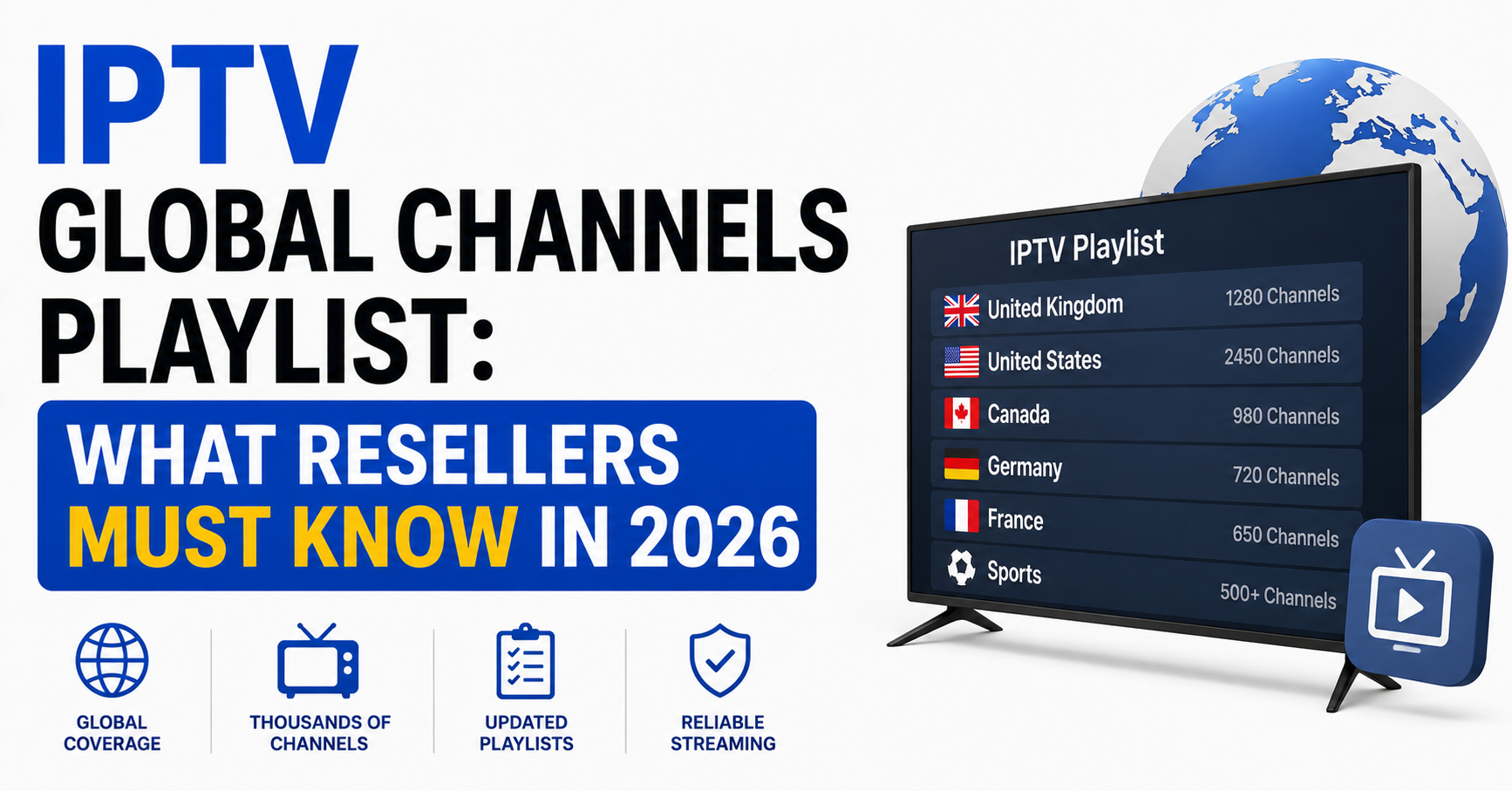
Walk into any IPTV reseller forum right now and you’ll find the same complaint cycling through every thread — a panel advertised 18,000 channels in their IPTV global channels playlist, and half of them buffer, freeze, or simply don’t load. The channel count was real. The working channel count wasn’t. That gap between what’s listed and what actually plays at 8pm on a Saturday night is where reseller businesses quietly bleed to death.
This article isn’t going to hand you a list of features and call it a day. If you’re building a IPTV UK reseller operation around a global playlist, you need to understand infrastructure, regional instability, ISP countermeasures, and the psychology of subscriber churn — because all of those hit you at the same time when things go wrong.
The “Every Channel Works” Myth That Kills New Reseller Panels
Here’s the first conversation every panel operator has with a new reseller or household buyer shopping for an IPTV global channels playlist: they expect every single channel listed in that playlist to work, all day, every day.
That expectation is completely detached from how IPTV infrastructure actually functions. Channels in a global playlist pull from dozens of different source servers across multiple continents. Each source has its own uptime profile, its own peak-hour congestion pattern, and its own vulnerability to ISP-level blocking. A playlist might genuinely contain 15,000 channel entries, but at any given moment, the number that stream without buffering could be significantly lower.
Pro Tip: Before you sign up with any panel provider, ask for the working channel ratio during peak hours — not the total channel count. A provider with 8,000 channels and a 92% uptime rate will make you more money than one advertising 20,000 channels at 60% reliability.
This distinction matters because your subscribers don’t care about your backend. They care that the football match they sat down to watch at 9pm actually plays. When it doesn’t, they message your reseller. Your reseller messages you. And if you can’t fix it fast, both of them leave.
Why Peak-Hour Stress Testing Separates Operators From Hobbyists
Anyone can test an IPTV global channels playlist at 2pm on a Tuesday and declare it flawless. That’s meaningless. The real test happens during peak viewing hours — typically 7pm to 11pm in the subscriber’s local timezone — when server load spikes, bandwidth gets contested, and weak infrastructure starts showing cracks.
Manual spot-checking during peak hours is the only honest method. Automated monitoring tools exist, but they don’t replicate what a subscriber actually experiences: the buffer wheel appearing mid-stream, the audio dropping for three seconds, the EPG data lagging behind the actual broadcast.
What you’re looking for during a peak-hour test of any IPTV global channels playlist:
- Channel zap time (how fast a channel loads when you switch to it — anything over 3 seconds is a problem)
- Mid-stream buffer events during the first 10 minutes of playback
- Audio-video sync drift on HD and FHD streams
- EPG accuracy — does the programme guide match what’s actually airing?
If a provider can’t hold up during Friday and Saturday evenings across at least three different regional channel categories, their infrastructure isn’t ready for a reseller ecosystem.
South Asian and Middle Eastern Channels: The Global Playlist’s Weak Spot
Not all regions inside an IPTV global channels playlist are created equal. If you’ve operated panels serving diaspora communities in the UK and Europe, you already know this — South Asian and Middle Eastern channel categories are the most unstable segments in almost every global playlist on the market.
The reasons stack up. Source servers for these regions are often located in jurisdictions with aggressive ISP filtering. Uplink reliability fluctuates more than Western European or North American feeds. And demand spikes are extreme — when a cricket match or a Ramadan series is airing, those servers get hammered in ways that North American sports streams rarely experience.
Pro Tip: If your IPTV global channels playlist includes South Asian or Middle Eastern content, confirm that your provider maintains backup uplink servers specifically for those regions. A single-source setup for these categories is a guaranteed failure point during high-demand events.
For resellers targeting Pakistani, Indian, Bangladeshi, Arab, or Turkish-speaking subscribers, this isn’t a minor detail. It’s the core of your value proposition. If those channels don’t work reliably, your entire subscriber base has a reason to leave.
Inflated Playlist Numbers vs. the Metric That Actually Matters
Panel providers love big numbers. “20,000+ channels” sounds impressive on a landing page. But as an operator who’s tested dozens of panels, here’s the uncomfortable truth about any IPTV global channels playlist — most of those 20,000 entries fall into categories that don’t drive revenue.
Duplicate feeds, inactive test channels, regional variants of the same broadcast, adult content that most resellers disable anyway, and channels in languages with no subscriber demand in your market. Strip all of that away, and the working channel count that matters to your business might be closer to 4,000–6,000.
| Metric | Inflated Playlist | Operator-Verified Playlist |
|---|---|---|
| Advertised channel count | 18,000–22,000 | 6,000–9,000 |
| Working channels at peak | 55–65% | 88–95% |
| Unique (non-duplicate) feeds | ~40% of listed | ~85% of listed |
| Regional backup sources | Rarely | Standard |
| EPG coverage | Partial | Comprehensive |
| Subscriber complaint rate | High | Manageable |
The smarter approach to evaluating any IPTV global channels playlist is to ignore the headline number entirely and focus on three things: working ratio during peak hours, EPG accuracy, and whether the provider maintains redundant sources for high-demand categories.
What Happens When Channels Disappear Mid-Month
Channels vanish. It’s not a question of if — it’s when. A source goes down, an uplink gets pulled, an ISP starts blocking a specific CDN, or a licensing enforcement action takes out an entire category overnight. When this happens in the middle of a billing cycle, the clock starts ticking on your churn rate.
Here’s the damage-control workflow that actually works when your IPTV global channels playlist loses a chunk of content:
- Announce immediately. Don’t wait for complaints to pile up. Push a message to your resellers through Telegram, WhatsApp, or whatever channel you use for operational updates. Transparency buys you time that silence never will.
- Switch source. If your panel provider offers backup feeds or alternative uplinks, activate them. If they don’t, escalate directly to the provider’s technical team — and if they can’t resolve it within hours, that tells you something about their infrastructure.
- Credit affected accounts. Proactive credits — even small ones — dramatically reduce churn. A subscriber who receives a 2-day extension without asking is far less likely to cancel than one who has to chase you for compensation.
Pro Tip: Build a templated announcement message for channel outages before they happen. When things go wrong, speed matters more than polish. Having a pre-written template saves you 20 minutes of panic-writing while complaints are flooding in.
DNS Poisoning, DPI, and the ISP Arms Race Against Global Playlists
Any serious conversation about running an IPTV global channels playlist in 2026 has to address ISP-level blocking — because it’s no longer occasional. It’s systematic.
The techniques ISPs deploy have evolved significantly. DNS poisoning remains the most common first-line measure, redirecting playlist URLs to dead endpoints. But deep packet inspection has become far more sophisticated. Modern DPI systems can identify IPTV traffic patterns even when the content itself is encrypted, by analysing packet timing, payload sizes, and connection behaviour.
For resellers, this means your subscribers’ experience with your IPTV global channels playlist depends partly on which ISP they’re using and what countermeasures your panel provider has in place. DNS-over-HTTPS, SNI masking, and rotating CDN endpoints are no longer optional features — they’re baseline infrastructure requirements.
What to verify with your provider:
- Do they support DNS-over-HTTPS or DNS-over-TLS for playlist delivery?
- Are CDN endpoints rotated regularly, or do they rely on static URLs?
- Is there an automated failover system when a primary delivery path gets blocked?
- Do they monitor ISP blocking patterns and proactively adjust?
If the answer to any of those is no, your IPTV global channels playlist is operating on borrowed time in markets with aggressive ISP enforcement.
HLS Latency, Load Balancing, and the Infrastructure Nobody Sees
The subscriber sees a channel. The reseller sees a credit balance. But underneath every IPTV global channels playlist sits a stack of infrastructure decisions that determine whether either of them stays happy.
HLS latency is one of the invisible killers. A playlist might technically work, but if the HLS segmentation is poorly configured, subscribers experience a 15–30 second delay compared to traditional broadcast. For live sports, that delay means spoilers from social media arrive before the goal appears on screen. It sounds trivial until you’re fielding complaints from fifty angry football fans on a Saturday afternoon.
Load balancing is the other half of this equation. A well-architected IPTV global channels playlist distributes viewer connections across multiple servers so that no single node gets overwhelmed during peak hours. Cheap infrastructure skips this entirely — every subscriber in a region hits the same server, and when that server reaches capacity, everyone buffers simultaneously.
Pro Tip: Ask your provider whether they use geographic load balancing or simple round-robin. Geographic load balancing routes subscribers to the nearest healthy server, reducing latency and improving stream stability. Round-robin just cycles through a list and hopes for the best.
Panel Credits, Pricing Models, and Margin Protection for Resellers
A reliable IPTV global channels playlist is only half the equation. If your panel’s credit structure eats into your margins, channel quality becomes irrelevant because you won’t be in business long enough to benefit from it.
The standard credit-based model works like this: you buy credits in bulk from a panel provider, each credit activates a subscription for a set duration, and your profit is the difference between your credit cost and what you charge the end subscriber. Simple enough — until you factor in refunds, chargebacks, free trials that don’t convert, and the credits you burn testing channels yourself.
Margin protection strategies that experienced resellers use:
- Never offer monthly subscriptions at a price point that leaves less than 40% gross margin after credit cost
- Bundle your IPTV global channels playlist access with value-adds (custom EPG, branded apps, priority support) to justify higher pricing
- Track your credit-to-conversion ratio monthly — if you’re burning more than 5% of credits on trials and tests, tighten your funnel
- Negotiate volume discounts at purchase thresholds and lock in rates before peak seasons
The resellers who survive long-term aren’t the ones with the cheapest prices. They’re the ones who understand their unit economics well enough to absorb the inevitable disruptions — channel outages, source switches, and the occasional mass refund event — without going underwater.
Subscriber Churn Psychology: Why People Actually Cancel
Most resellers assume subscribers cancel because of buffering. That’s partially true, but the psychology of churn inside an IPTV global channels playlist ecosystem is more layered than a single technical complaint.
Subscribers leave for three reasons, in order of frequency: broken expectations, poor communication, and better alternatives. Buffering is a subset of broken expectations, but so is a channel disappearing from the playlist, an EPG showing the wrong programme, or a stream quality downgrade from FHD to SD without explanation.
The communication gap is where resellers lose subscribers they could have kept. When something goes wrong and nobody tells the subscriber what happened or when it’ll be fixed, the subscriber assumes nobody is working on it. That’s when they start searching for alternatives — and once they’re searching, you’ve already lost them emotionally even if they haven’t cancelled yet.
Reducing churn on your IPTV global channels playlist:
- Set realistic expectations at onboarding — tell subscribers upfront that channel availability can fluctuate and that you actively monitor quality
- Respond to complaints within 2 hours during peak viewing times
- Send proactive updates during outages, even if the update is “we’re aware and working on it”
- Offer loyalty credits or extended subscription time for long-term subscribers who experience repeated issues
Scaling From 50 to 500 Subscribers Without Breaking Your Playlist
There’s a threshold every reseller hits where their IPTV global channels playlist setup that worked beautifully for 50 subscribers starts cracking under the weight of 200 or 300 concurrent viewers. This isn’t a failure of the playlist itself — it’s a failure to scale infrastructure alongside subscriber growth.
The mistakes are predictable. Resellers add subscribers without confirming their panel provider can handle the additional concurrent connections. They don’t upgrade their own management tools. They keep using the same single Telegram group for support that worked when they had 30 customers, and it becomes chaos at 300.
Scaling requires deliberate decisions at each growth stage:
- 50–100 subscribers: Your panel’s base infrastructure handles this. Focus on retention, not expansion.
- 100–250 subscribers: Confirm concurrent connection limits with your provider. Start segmenting support channels by issue type.
- 250–500 subscribers: You need a provider with geographic load balancing, backup uplinks, and an SLA. Consider a secondary panel as a failover source for your IPTV global channels playlist.
Pro Tip: The cheapest time to negotiate better terms with your panel provider is before you need them. Approach your provider about upgraded infrastructure and volume pricing when you’re at 150 subscribers, not when you’re at 400 and already experiencing problems.
Frequently Asked Questions
How often do channels drop from an IPTV global channels playlist?
Channel availability fluctuates daily. During stable periods, you might see 1–3% of channels cycling in and out. During enforcement waves or source server outages, entire categories can go offline temporarily. Reliable providers restore affected channels within hours by switching to backup uplinks, but no playlist maintains 100% uptime across every region continuously.
What’s a healthy working channel ratio for a quality IPTV global channels playlist?
Anything above 88% working channels during peak hours is considered strong. Below 80%, subscribers start noticing gaps and complaints increase sharply. Always test during evening peak hours in your primary subscriber timezone rather than relying on daytime checks, which paint an artificially positive picture of playlist health.
Can I test an IPTV global channels playlist before committing to a panel?
Most reputable panel providers offer 24–48 hour trial credits. Use this window exclusively during peak evening hours across multiple channel categories — particularly South Asian and Middle Eastern content if those are relevant to your market. A trial that only covers off-peak hours tells you almost nothing useful about real-world reliability.
Why do South Asian and Middle Eastern channels buffer more than European ones?
Source server infrastructure for these regions is typically less redundant than Western European feeds. Combined with higher demand spikes during cultural events, religious programming, and cricket matches, these categories experience disproportionate load. Providers who maintain dedicated backup uplinks for these regions deliver noticeably better stability.
Is DNS-over-HTTPS necessary for delivering an IPTV global channels playlist in 2026?
In markets with active ISP-level blocking — which now includes most of Western Europe and parts of North America — DNS-over-HTTPS is effectively mandatory. Without it, playlist URLs are vulnerable to DNS poisoning, which redirects subscriber connections to dead endpoints. Any provider not supporting encrypted DNS delivery is exposing your business to preventable outages.
How many credits should I keep in reserve as an IPTV reseller?
Maintain a buffer of at least 15–20% above your projected monthly activation volume. This covers trial activations, goodwill credits issued during outages, and unexpected subscriber spikes. Running your credit balance to zero during a high-demand period means you can’t onboard new subscribers at the exact moment demand peaks.
What’s the difference between geographic load balancing and round-robin distribution?
Geographic load balancing routes each subscriber to the nearest healthy server, minimising latency and distributing load intelligently. Round-robin simply cycles connections through a server list regardless of location or load. For an IPTV global channels playlist serving subscribers across multiple countries, geographic balancing produces measurably fewer buffering events.
Should I offer refunds when channels go down in my IPTV global channels playlist?
Proactive credits are more effective than reactive refunds. Extending a subscriber’s access by 1–3 days after a significant outage costs you very little but dramatically reduces cancellation rates. Waiting for subscribers to demand refunds creates an adversarial dynamic that accelerates churn even if you eventually pay out.
Your IPTV Global Channels Playlist Success Checklist
- Request the working channel ratio from your provider — not the advertised total. If they can’t provide it, that’s your answer.
- Run manual spot-checks during peak hours (7–11pm in your subscriber’s timezone) every Friday and Saturday for at least two weeks before committing.
- Test South Asian and Middle Eastern channel categories separately — they’ll fail first under load.
- Confirm your provider uses DNS-over-HTTPS and rotates CDN endpoints. Ask directly and get a clear answer.
- Build your outage announcement template today — before you need it.
- Maintain a 15–20% credit buffer above projected monthly activations at all times.
- Set subscriber expectations during onboarding: explain that playlists fluctuate and that you actively monitor quality.
- Track your credit-to-conversion ratio monthly and cut trial access if it exceeds 5% of total credits.
- At 150 subscribers, start negotiating upgraded infrastructure terms — don’t wait until you’re already struggling at 400.
- Explore trusted IPTV reseller panel options at British Reseller to compare infrastructure quality before scaling your operation.