The Question That Follows Every IPTV User Home
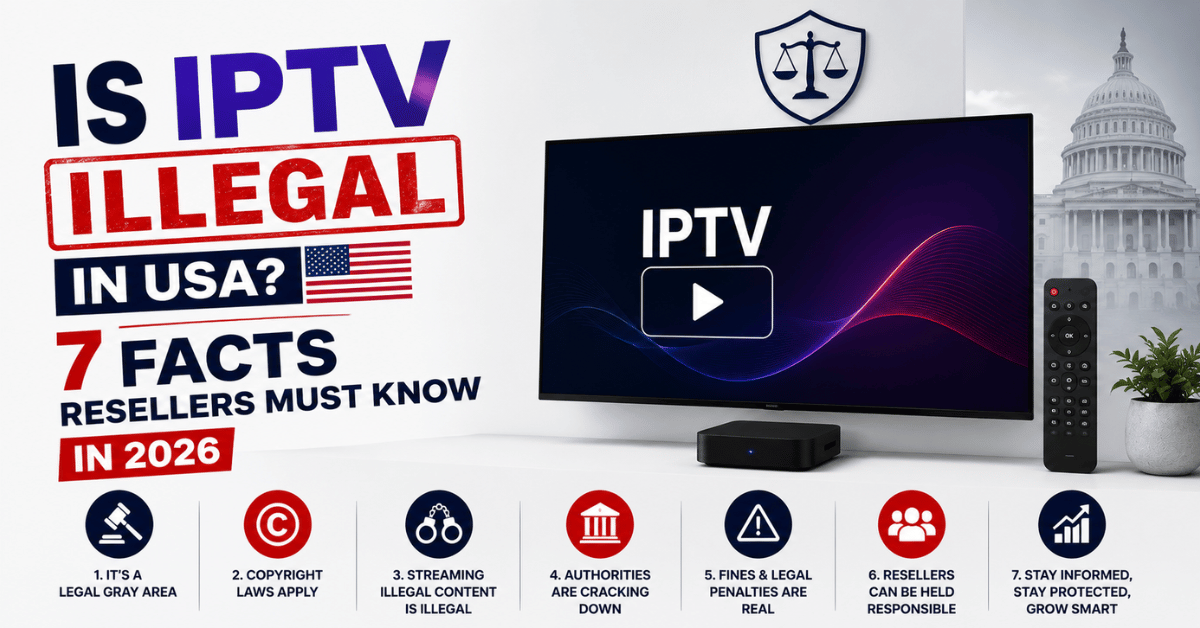
Somewhere between clicking “Subscribe” and watching your first live stream, the thought creeps in. Is IPTV illegal in USA? You hear conflicting answers from Reddit threads, YouTube reviewers, and the guy who sold you a panel. Nobody gives you a straight answer because, frankly, the answer isn’t straight.
IPTV as a technology is perfectly legal. It’s a delivery method — packets of video data traveling over internet protocol instead of through a coaxial cable or satellite dish. Netflix uses it. Disney+ uses it. Every major broadcaster with a streaming arm uses it. The technology itself has never been the problem.
The problem starts when someone uses that technology to redistribute content they don’t have the rights to carry. And that’s where the “is IPTV illegal in USA” conversation turns from simple to deeply complicated, especially if you’re a UK IPTV reseller building a business around panel credits and customer subscriptions.
Let’s cut through the noise.
Federal Law and Where IPTV Sits in 2026
In December 2020, the US Congress passed the Protecting Lawful Streaming Act as part of a broader spending bill. Before that legislation, unauthorized streaming was treated as a misdemeanor under most circumstances. The new law elevated commercial-scale illegal streaming to a felony offense, carrying penalties of up to ten years in prison for repeat offenders.
That shift matters enormously when you ask whether is IPTV illegal in USA from a reseller’s perspective. The law doesn’t target individual viewers casually watching a stream. It targets people who operate services — anyone running, promoting, or profiting from unauthorized streams at a commercial level.
Pro Tip: The Protecting Lawful Streaming Act specifically uses the phrase “commercial advantage or private financial gain.” If you’re selling subscriptions, you’re operating commercially. Period. Understand where you sit before you scale.
For subscribers watching from home, the legal exposure remains minimal in practice. No US prosecutor has successfully brought charges against an individual end-user simply for watching an unauthorized IPTV stream. But “minimal risk” and “no risk” are two very different things, and the enforcement landscape shifts constantly.
Why “Legal” and “Illegal” Are the Wrong Categories
Most people asking is IPTV illegal in USA want a binary answer. Legal or illegal. Safe or dangerous. The reality operates on a spectrum, and where you fall on that spectrum depends on three variables: what content is being delivered, who holds the distribution rights, and what your role is in the chain.
| Factor | Legal IPTV | Unlicensed IPTV |
|---|---|---|
| Content source | Licensed from rights holders | Restreamed without authorization |
| Examples | Netflix, Hulu, Sling TV | Unnamed panel-based services |
| Subscriber risk | None | Low but non-zero |
| Reseller risk | None | Significant and growing |
| Payment trail | Transparent, taxable | Often crypto or informal |
| Infrastructure | Cloud-hosted, CDN-backed | Rotating servers, offshore hosting |
The grey zone exists because the technology is identical on both sides. An HLS stream from a licensed source and an HLS stream from an unlicensed source look the same to your router, your ISP, and your device. The difference is entirely about rights and authorization — things that happen upstream, long before the packets reach your screen.
What US ISPs Are Actually Doing About It
Forget what the law says on paper for a moment. What matters day-to-day for subscribers and resellers is what ISPs are doing in practice. And in 2026, they’re doing more than ever.
AI-driven traffic analysis has matured significantly. Major ISPs now deploy deep packet inspection systems that can identify IPTV traffic patterns even when encrypted. They’re not reading your content — they’re reading your behaviour. Persistent connections to specific port ranges, consistent high-bandwidth UDP streams during peak sports hours, DNS queries to known panel domains. The fingerprint is recognizable.
When an ISP identifies likely unauthorized IPTV usage, the response varies:
- Throttling bandwidth during detected streaming sessions
- Sending copyright infringement notices under the DMCA framework
- Flagging accounts for repeated violations
- In extreme cases, terminating service agreements
Pro Tip: DNS poisoning is the cheapest enforcement tool ISPs have. If your customers suddenly can’t connect, check whether their ISP has poisoned the DNS resolution for your panel’s domain before you blame your server infrastructure.
This is why the question “is IPTV illegal in USA” matters practically, not just theoretically. Even if no prosecutor knocks on a subscriber’s door, their ISP might quietly degrade their experience until the service becomes unusable.
The Reseller’s Legal Exposure Is Different From the Viewer’s
Here’s where most articles on this topic fail. They lump subscribers and resellers into the same risk bucket. They aren’t in the same bucket. They aren’t even in the same building.
If you’re asking is IPTV illegal in USA as someone who watches streams at home, your practical risk profile is low. You might receive an ISP warning letter. You might get throttled. But criminal prosecution for personal viewing remains effectively nonexistent in the American legal system as of mid-2026.
If you’re asking the same question as a reseller — someone who buys panel credits wholesale, creates subscriptions, manages customer accounts, and collects payment — your exposure is categorically different. The Protecting Lawful Streaming Act was written with you in mind. Not literally, but operationally.
Resellers occupy the distribution layer. You are the person enabling access at scale. And scale is exactly what triggers federal interest.
- Selling more than a handful of subscriptions moves you into “commercial advantage” territory
- Accepting payment creates a financial trail
- Marketing your service publicly creates documentary evidence
- Operating customer support infrastructure demonstrates organizational intent
None of this means every reseller will face prosecution. Most won’t. But the legal architecture exists to pursue them, and enforcement actions have increased year over year since the Act passed.
Enforcement Actions That Actually Happened
Theory is cheap. Let’s talk about what enforcement has actually looked like.
US authorities have historically focused on the biggest targets — the operators running the servers and master panels rather than downstream resellers. Operations against large-scale services have resulted in multimillion-dollar seizures and criminal indictments. The targets share common characteristics: high subscriber counts, significant revenue, visible marketing, and identifiable operators.
But the net has widened. In 2024 and 2025, several mid-tier reseller operations faced civil suits from content rights holders. These weren’t criminal prosecutions — they were civil actions seeking damages and injunctions. The distinction matters because civil suits have a lower burden of proof and can be financially devastating even without a criminal conviction.
Pro Tip: Rights holders increasingly use automated monitoring tools that crawl social media, forums, and even Telegram groups to identify reseller operations. If you’re marketing openly with screenshots of channel lists featuring premium sports content, you’re handing them evidence on a silver platter.
When someone asks is IPTV illegal in USA, they’re usually thinking about police and handcuffs. The more realistic threat for most resellers is a civil cease-and-desist followed by a lawsuit they can’t afford to fight.
The VPN Misconception and Why It Doesn’t Solve What You Think
A significant number of IPTV users and resellers believe a VPN renders the legality question moot. It doesn’t. A VPN changes your apparent IP address and encrypts your traffic between your device and the VPN server. That’s it.
A VPN does not change the legal status of the content you’re accessing. If is IPTV illegal in USA for a particular service without a VPN, it remains equally unlicensed with one. The VPN affects detectability, not legality. Those are separate issues that people conflate constantly.
For resellers, VPN reliance creates additional operational problems:
- Customers who don’t configure VPNs correctly flood your support channels
- VPN overhead introduces latency that degrades stream quality
- Some IPTV middleware conflicts with certain VPN protocols
- Load balancing becomes more complex when traffic routes through third-party tunnels
The smarter approach isn’t to hide behind a VPN and pretend the legal question disappears. It’s to understand exactly what content your panel carries, where it’s sourced, and what rights — if any — the upstream provider holds.
What “Licensed IPTV” Actually Means in Practice
People throw around the term “licensed” without understanding what it requires. A licensed IPTV service has negotiated distribution agreements with content rights holders for every channel and piece of content it carries, within the specific geographic territories it serves.
This is why legitimate services like Sling TV, YouTube TV, and FuboTV cost what they cost. Those licensing fees represent the bulk of their operating expenses. When an IPTV service offers thousands of channels — including premium sports streams, pay-per-view events, and international content — for a fraction of the price, the licensing math doesn’t add up. It can’t add up.
That economic reality is often the clearest answer to “is IPTV illegal in USA” for any specific service. If the price is too low to cover licensing costs, the content almost certainly isn’t licensed.
| Cost Component | Licensed Service | Unlicensed Service |
|---|---|---|
| Content licensing per subscriber | High (majority of cost) | Zero |
| Server infrastructure | Enterprise-grade CDN | Rotating offshore servers |
| Monthly subscriber price | Typically above thirty dollars | Often under fifteen dollars |
| Channel count | Dozens to low hundreds | Thousands |
| Legal compliance team | Yes | No |
| Backup uplink servers | Redundant, contracted | Ad hoc, unreliable |
Customer Churn and the Legal Anxiety Factor
Here’s something resellers don’t talk about enough. The question “is IPTV illegal in USA” isn’t just a legal concern — it’s a churn driver. Customers who feel anxious about legality cancel. They cancel quietly, without telling you why. They just disappear.
Managing that anxiety is part of managing your business. Resellers who ignore it lose subscribers to services that address it — either legitimate streaming platforms or competitors who are better at framing their offering.
The psychology works like this: a customer subscribes, enjoys the service for a few months, then sees a news article about an IPTV crackdown. Suddenly every buffer, every brief outage, feels like the walls closing in. They start wondering if their ISP is watching. They switch back to cable or sign up for a bundle of legitimate streaming apps.
Pro Tip: Customer education is retention. Resellers who proactively explain how their service works — without making promises about legality they can’t keep — retain subscribers longer than those who dodge the question entirely.
This churn pattern accelerates during high-profile enforcement actions. Every time a major IPTV service gets shut down, every reseller in the ecosystem feels the ripple through cancellation rates.
Scaling a Reseller Operation Without Painting a Target
If you’ve decided to operate as a reseller despite understanding the legal landscape, the way you scale determines your risk profile as much as what you sell. Operators who’ve survived enforcement waves share certain characteristics.
They keep infrastructure distributed. Not one server cluster in one data centre, but load-balanced nodes across multiple providers. When one goes down — and nodes do go down, whether from enforcement, DDoS attacks, or simple hardware failure — the others absorb the load. This isn’t just good business practice. It’s survival.
They manage their panel credits carefully. Overbuying credits from a single upstream provider creates a single point of failure. Diversified sourcing across multiple panels means one provider’s shutdown doesn’t instantly orphan your entire customer base.
They stay quiet. The resellers who get noticed are the ones marketing on social media with screenshots of channel lists, advertising on public forums, and running Google Ads targeting keywords like “cheap IPTV USA.” The ones who survive operate through word of mouth, private referral networks, and closed communities.
- Never publicly list specific channels, especially premium sports content
- Process payments through methods that don’t scream “unlicensed streaming service”
- Maintain backup uplink servers that can activate within hours, not days
- Monitor ISP blocking trends in your customers’ geographic areas
The 2026 Enforcement Landscape and What’s Coming Next
The question “is IPTV illegal in USA” in 2026 carries more weight than it did even two years ago. Several trends are converging.
First, AI-driven content identification has become standard among major rights holders. Automated systems monitor streams in real time, matching content fingerprints against licensed distribution databases. When a match appears on an unlicensed service, the documentation process begins automatically.
Second, international cooperation on intellectual property enforcement has tightened. US authorities now coordinate more effectively with counterparts in countries where IPTV infrastructure is commonly hosted. Server seizures in one jurisdiction can trigger parallel investigations in others.
Third, payment processor scrutiny has increased. Platforms that process payments for IPTV services face their own compliance pressures. Several payment processors have begun flagging and freezing accounts associated with IPTV reseller operations, making it harder to maintain stable payment pipelines.
Pro Tip: If your payment processing gets frozen, don’t just switch processors and carry on. The freeze itself is a signal. Understand why it happened before you expose a new payment channel to the same risk.
For resellers, these converging trends mean the operational complexity of running a sustainable business increases every quarter. The margins between viable operation and unacceptable risk continue to narrow.
What Subscribers Should Actually Worry About
Let’s reframe “is IPTV illegal in USA” from the subscriber’s side one final time. If you’re a household user — someone who just wants to watch live television without a cable contract — here’s your realistic risk assessment.
Criminal prosecution: effectively zero for personal use. No US case has successfully prosecuted an individual end-user for watching an unauthorized IPTV stream.
Civil liability: theoretically possible but practically unlikely for individual viewers. Rights holders pursue distributors, not the audience.
ISP consequences: this is your actual risk. Throttling, warning letters, and in rare cases service termination. These are real, documented, and increasingly common.
Device security: many IPTV applications require sideloading, which bypasses standard app store security screening. Malicious APKs are a genuine concern — they can carry adware, credential harvesters, or worse.
Data privacy: your viewing habits, device information, and sometimes payment details flow through infrastructure you know nothing about. There’s no privacy policy enforcement when the service itself operates outside regulatory frameworks.
Frequently Asked Questions
Is IPTV illegal in USA for personal viewing at home?
IPTV technology itself is completely legal in the USA. The legality depends on whether the service you’re using holds proper content distribution licenses. Watching licensed services like Sling TV or YouTube TV is entirely lawful. Using unlicensed services carries minimal but non-zero legal risk for individual viewers, with ISP throttling being the most realistic consequence rather than criminal prosecution.
Can I get arrested for using IPTV in the United States?
No individual end-user has been criminally prosecuted in the US simply for watching an unauthorized IPTV stream. The Protecting Lawful Streaming Act targets commercial-scale operators and distributors, not casual viewers. Your practical risks are ISP warnings and throttling, not arrest. However, laws can evolve, so this isn’t a permanent guarantee.
Is IPTV illegal in USA if I use a VPN?
A VPN does not change the legal status of any content you access. It encrypts your traffic and masks your IP address, which affects detectability but not legality. If a service is unlicensed, accessing it through a VPN doesn’t make it licensed. VPNs can also introduce latency and compatibility issues with some IPTV middleware.
How do I know if an IPTV service is licensed or not?
Price is the strongest indicator. Licensed content distribution requires expensive agreements with rights holders. If a service offers thousands of channels including premium sports for under fifteen dollars per month, the licensing math doesn’t work. Legitimate services are transparent about their licensing, list fewer channels, and charge prices that reflect real content costs.
Is IPTV illegal in USA for resellers specifically?
Resellers face significantly higher legal exposure than individual viewers. The Protecting Lawful Streaming Act targets anyone profiting commercially from unauthorized streaming. Selling subscriptions, managing panels, collecting payments, and marketing services all establish commercial intent. Civil suits from rights holders are the most common enforcement mechanism against mid-tier resellers.
What happens if my ISP detects IPTV usage?
ISPs use AI-driven deep packet inspection to identify IPTV traffic patterns. Responses range from throttling your bandwidth during streaming sessions to sending DMCA notices, flagging your account for repeated violations, or terminating your service agreement. DNS poisoning — where your ISP blocks resolution of known IPTV panel domains — is also increasingly common.
Is IPTV illegal in USA differently from other countries?
Yes. Legal frameworks vary significantly by jurisdiction. The USA’s Protecting Lawful Streaming Act creates felony-level penalties for commercial-scale unauthorized streaming, which is stricter than many countries. Some nations have weaker enforcement mechanisms or different copyright frameworks. Resellers serving US customers operate under US legal exposure regardless of where they’re personally located.
Can rights holders sue individual IPTV subscribers in the USA?
Theoretically yes, but practically this almost never happens. Rights holders focus enforcement resources on operators and distributors because the legal precedent, financial recovery, and deterrent effect are far greater. Individual subscriber lawsuits are costly relative to potential damages and generate minimal strategic value for rights holders.
Your Execution Checklist Before You Do Anything Else
Audit every channel on your panel. If you can’t verify licensing for a content source, assume it’s unlicensed and price your risk accordingly.
Set up DNS monitoring for your customer base. When ISPs start poisoning resolutions, you need to know before your support tickets tell you.
Diversify your panel sourcing. One upstream provider going dark shouldn’t end your business overnight. Spread your credit purchases across at least two or three independent panels.
Kill your public marketing. Move customer acquisition to private referral channels, closed groups, and word of mouth. Every public ad is a timestamped piece of evidence.
Establish backup uplink servers in at least two separate hosting jurisdictions. Test failover monthly, not when disaster has already struck.
Review your payment processing monthly. If your processor starts asking questions or requesting additional documentation, take it seriously — it’s an early warning system.
Educate your customers proactively. A subscriber who understands the landscape stays longer than one who panics at the first news headline.
Visit britishreseller.com for a deeper look at how established IPTV reseller operations structure their panel systems and credit models.