The Renewal That Never Came
Three hundred active customers. Solid uptime. Competitive pricing. And still, a reseller watched thirty percent of his base quietly disappear over two months without a single complaint ticket raised.
That is the version of IPTV customer management that nobody warns you about — silent churn. Not angry customers. Not outages. Just people who didn’t bother renewing because nobody made the experience worth renewing for.
Effective IPTV customer management is not a support ticket queue. It is the entire operating relationship between your panel, your customers, and your ability to anticipate problems before they become exits. In the UK market specifically, where ISP throttling, DNS interference, and a crowded reseller landscape create constant friction, the operators who retain customers long-term are the ones who treat management as infrastructure — not an afterthought.
This guide is written from the field. The observations here come from real panel operations, real migration projects, and real customer behavior patterns. If you are running an IPTV UK reseller business in the UK and haven’t built a structured approach to IPTV customer management yet, what follows is the most honest account of what that actually requires.
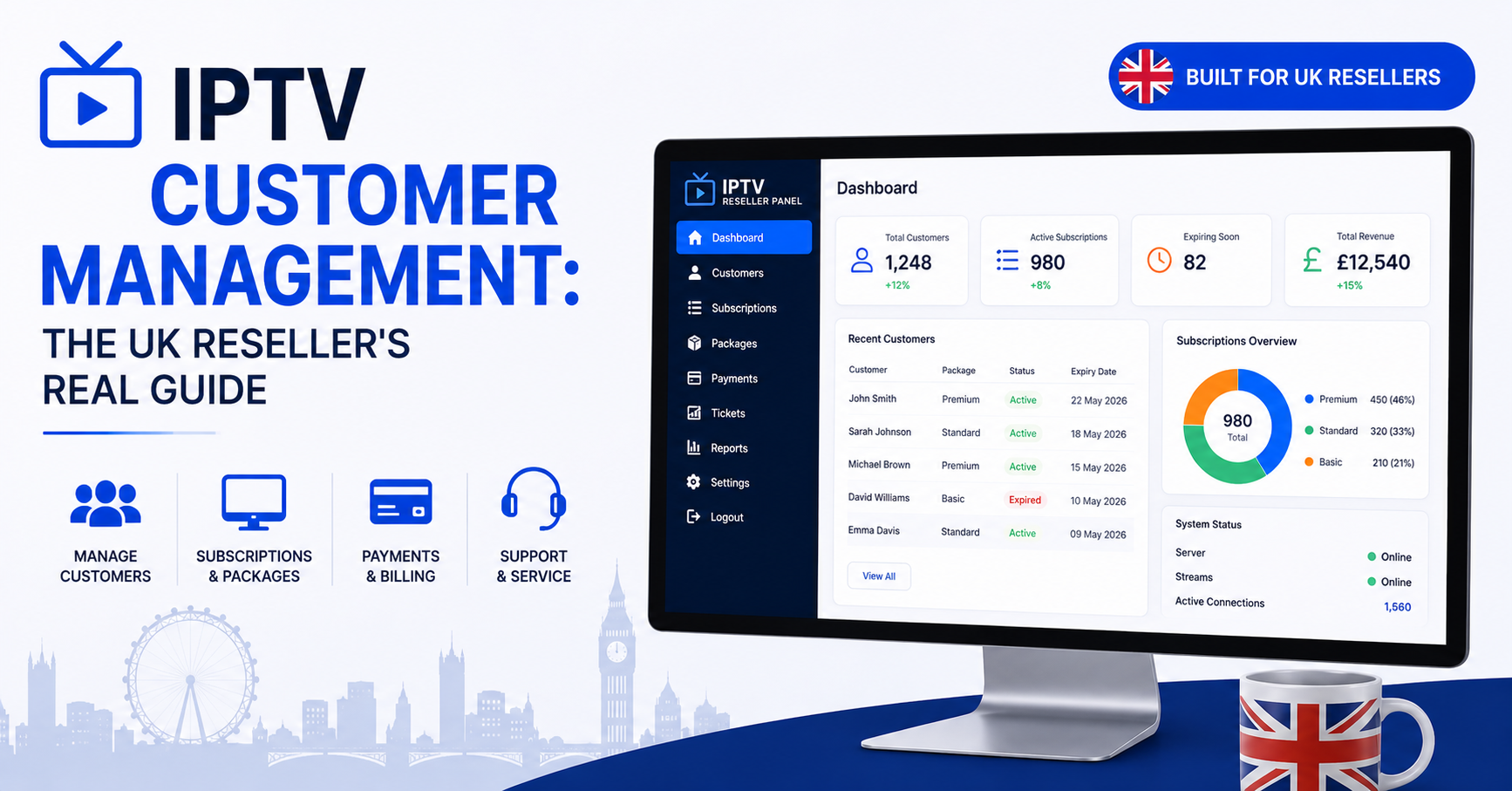
What “Customer Management” Actually Means at Panel Level
Most new resellers assume IPTV customer management means responding to WhatsApp messages and renewing credits on time. That understanding gets you to maybe sixty customers before the wheels come off.
At panel level, customer management is a four-layer operation:
- Provisioning — how cleanly and quickly a new line is activated
- Monitoring — detecting service degradation before customers report it
- Retention — structured communication around renewals, not last-minute scrambles
- Support triage — separating infrastructure issues from device issues from user error
When these four layers operate independently with no process connecting them, every incident becomes reactive. One server migration we assisted with in late 2024 revealed that the reseller had zero system for distinguishing between customers who messaged about buffering due to a genuine server issue versus customers whose Firestick needed a cache clear. Both groups received identical delayed responses. The server issue customers churned. The Firestick customers churned too — because they waited three days for a reply that should have taken three minutes.
Pro Tip: Build a response template library with at least fifteen pre-written replies covering the most common support scenarios — buffering, EPG not loading, app crashes, expired lines, wrong playlist URL. This alone cuts support handling time by forty percent and makes your service feel professional at scale.
The Reseller Mistake That Destroys Retention Silently
After reviewing hundreds of support interactions across multiple reseller panels, one pattern appears more than any other: resellers who treat every customer issue as equally urgent end up treating none of them urgently enough.
Effective IPTV customer management requires triage logic. Not all issues carry the same churn risk.
| Issue Type | Churn Risk | Response Priority |
|---|---|---|
| All channels down | Critical | Immediate |
| Specific bouquet missing | High | Same day |
| EPG not updating | Medium | Within 24 hours |
| Single channel buffering | Medium | Within 24 hours |
| App login confusion | Low | Within 48 hours |
| Renewal reminder | High | Proactive — before expiry |
The resellers who implement this kind of tiered response logic — even informally — retain significantly more customers than those who work through a single WhatsApp inbox in the order messages arrive. A customer whose entire service is down should never be waiting behind someone asking how to install IPTV Smarters Pro.
One observation from a scaling project: when a reseller introduced even a basic two-tier system — urgent versus non-urgent — average response time for critical issues dropped from six hours to under forty minutes. Renewal rates improved by eighteen percent within ninety days.
ISP Throttling Is a Customer Management Problem, Not Just a Technical One
Here is something that took operators time to fully accept: when BT or Virgin throttles IPTV traffic during peak hours, that is your customer management problem to solve — not just your infrastructure team’s problem.
Customers in the UK do not understand ISP throttling. They understand buffering. And when they buffer, their instinct is that the service is poor quality. Without communication, that instinct becomes a decision not to renew.
The resellers managing this well do two things:
First, they maintain a simple status awareness system — even a basic Telegram broadcast channel or WhatsApp broadcast list where they can push a message like: “Some customers may experience reduced performance this evening between 7–10pm due to peak-hour ISP traffic management. Our servers are fully operational. Use a VPN or DNS change to bypass this if needed.”
Second, they pre-empt the support wave. Sending that message before the complaints start signals competence. It tells the customer: someone is watching this for me.
Good IPTV customer management is partly a communications discipline. Infrastructure stability matters. But how you communicate around instability determines whether customers trust you through it.
Pro Tip: DNS changes — switching customers from their ISP’s default DNS to Cloudflare (1.1.1.1) or Google (8.8.8.8) — resolve a significant percentage of buffering complaints that are actually ISP-level interference rather than server issues. Document this as a standard troubleshooting step in your support templates and share it proactively with new customers during onboarding.
The Renewal Window Most Resellers Ignore
Renewal management is perhaps the single highest-leverage area of IPTV customer management that most resellers handle badly.
The standard approach: wait until a customer’s line expires, then respond when they message asking why it stopped working.
The result: a customer who had to chase you to continue paying you. That experience, repeated a few times, trains customers to think of your service as unreliable and your operation as disorganised. Even if the streaming itself is excellent.
A structured renewal system for IPTV customer management looks like this:
Day -7: First renewal reminder via WhatsApp or Telegram. Keep it friendly, not transactional. Mention any improvements, new channels, or upcoming sports events worth staying for.
Day -3: Second reminder. Include your payment options and confirm the process is quick.
Day -1: Final reminder. This is where you offer — if your margin allows — a small loyalty extension for long-term customers. Even two or three extra days demonstrates you value the relationship.
Day 0: If not renewed, send a message confirming the line has lapsed and offering easy reactivation. Do not ghost expired customers.
This sequence is manual at small scale. At larger scale, many resellers use Telegram bots or basic CRM spreadsheets with date-triggered reminders. The method matters less than the consistency.
One reseller operating across four hundred customers introduced this renewal system and reduced unintentional churn — customers who meant to renew but forgot — by over twenty-five percent within the first quarter.
What Good Onboarding Does for Long-Term Retention
Acquiring a new IPTV customer is expensive relative to retaining one. But most resellers spend zero time on structured onboarding, handing over a playlist URL and disappearing.
Good onboarding — as a component of IPTV customer management — looks like:
- A welcome message confirming the line is active and tested
- The recommended app for their device (TiviMate for Android boxes, IPTV Smarters Pro for Firestick, OttNavigator for power users)
- Basic setup instructions or a link to a walkthrough
- A note on what to do if they experience any issues — specifically who to contact and through which channel
- DNS recommendation for their router
This takes five minutes per new customer. The return on that five minutes is measurable. Customers who receive structured onboarding raise fewer support tickets in the first week, because they were given the right setup information upfront. Fewer tickets means less churn from setup frustration.
For resellers looking to operate at scale without sacrificing service quality, britishseller.co.uk provides panel access with the infrastructure stability that makes structured customer management actually achievable — because you cannot manage customers well when the underlying service is unreliable.
Panel Visibility: Managing What You Cannot See Is Impossible
A recurring failure mode in IPTV customer management is resellers who have no real-time visibility into their panel’s operational status. They find out about outages because customers message them. That is the worst possible detection system.
At minimum, resellers should have:
Line activity monitoring — knowing which lines are active and which have gone dark unexpectedly. A sudden drop in active connections during peak hours is an early signal of a server or stream issue.
Expiry dashboards — a clear view of how many lines are expiring in the next seven, fourteen, and thirty days. This feeds your renewal workflow directly.
Device diversity awareness — knowing what devices your customer base uses matters. If sixty percent of your customers use Firestick and Amazon releases a Fire OS update that breaks a popular IPTV app, you need to know that before fifty customers message you simultaneously.
ISP distribution — if you know many of your customers are on BT Broadband, and BT begins throttling IPTV traffic more aggressively in a given month, you can proactively communicate and advise a DNS or VPN workaround.
Most reseller panels provide export capabilities. Even a basic monthly audit of this data transforms reactive customer management into something approaching proactive operations.
Pro Tip: During a major Premier League fixture or major sporting event, your active connection count will spike significantly. Run a test connection sweep the morning before large events. A line that is technically active but delivering degraded stream quality will produce a flood of complaints during the match. Better to catch it at 10am than at kickoff.
When Customers Complain About Things That Aren’t Your Problem
An underappreciated dimension of IPTV customer management is knowing which complaints are genuinely within your control and which are not — and communicating that distinction clearly without sounding like you’re deflecting responsibility.
Common complaints that are not a reseller infrastructure problem:
- Buffering caused by the customer’s own broadband congestion (typically evenings, older routers, wifi interference)
- App crashes caused by outdated firmware on a Firestick or Android box
- EPG not loading because the customer hasn’t refreshed the guide within the app
- Missing channels after a bouquet update that the upstream provider made
Experienced IPTV customer management means you diagnose first, then respond. Sending a customer straight to “our servers are fine, check your internet” without actually verifying your server status is a common mistake that damages trust.
A better approach: acknowledge the issue, confirm your server status, then walk through device-side possibilities. This makes the customer feel heard even when the issue is on their end.
Sub-Reseller Management Is a Separate Discipline
If you are operating sub-resellers beneath you, IPTV customer management gains an additional layer of complexity that most guides completely ignore.
Your sub-resellers are customer-facing. Their customers are experiencing your infrastructure. When something goes wrong, you will receive escalations through your sub-reseller layer — often delayed, often incomplete, and sometimes inaccurate because the sub-reseller themselves misdiagnosed the issue.
Building a functional sub-reseller management layer requires:
- Clear escalation protocols (what they handle, what they escalate to you)
- A shared understanding of what information to collect before escalating (device, app, ISP, time of issue, error message)
- A dedicated communication channel separate from end-customer support
- Regular credit auditing to catch sub-resellers over-provisioning or under-reporting
A mistake we repeatedly see is main resellers treating sub-resellers as passive credit buyers rather than as operational extensions of the business. When a sub-reseller churns — taking their fifty customers with them to a competitor — it is often because the main reseller provided them no support infrastructure and no communication. They were just a credit invoice.
Pro Tip: Run a monthly brief with your active sub-resellers. Even a short Telegram voice note summarising server status, upcoming content, and any known issues builds a sense of partnership that pure transactional relationships never achieve.
Frequently Asked Questions
What is IPTV customer management and why does it matter for UK resellers?
IPTV customer management covers every operational process that affects the customer relationship — provisioning, support, renewals, communication, and retention. In the UK market, where ISP interference and reseller competition are both significant, structured IPTV customer management is what separates resellers who scale from those who stagnate. Poor management drives silent churn even when the service itself is technically sound.
How often should resellers communicate with their IPTV customers?
At minimum, at renewal windows and during any service disruption. Proactively is always better. A monthly broadcast message — even something brief covering upcoming sports, any app recommendations, or a troubleshooting tip — keeps your service visible and positions you as an operator who pays attention. Customers who hear from you regularly are less likely to quietly switch to a competitor.
What are the most common causes of IPTV customer churn in the UK?
Silent churn is most often caused by poor renewal communication, unresolved buffering issues that customers stopped bothering to report, and a general feeling that the reseller is unresponsive. Noisy churn — customers who leave and tell you why — is usually caused by extended outages, mishandled support, or pricing pressure from competitors. Effective IPTV customer management addresses both.
How should resellers handle customers experiencing buffering issues?
Diagnose before you respond. Confirm your server status first. Then work through: the customer’s broadband speed, router type and placement, app version, device firmware. The most common fixes for UK customers are a DNS change (Cloudflare 1.1.1.1) or a VPN to bypass ISP throttling. Having a documented troubleshooting checklist for support staff reduces handling time significantly.
What makes IPTV customer management different when managing sub-resellers?
Sub-resellers require escalation protocols, communication channels separate from end-user support, and regular operational briefings. They are not passive credit buyers — they are operational extensions. When they churn, they take their entire customer base. Treating sub-reseller relationships as partnerships rather than transactions has measurable impact on retention at both levels.
How do you reduce unintentional IPTV customer churn at renewal time?
A structured reminder sequence starting seven days before expiry is the most effective intervention. Combine that with a loyalty gesture for long-term customers — even a small credit or brief extension — and you address the two primary causes of unintentional churn: customers who forgot and customers who felt undervalued. Resellers who implement this consistently report renewal rate improvements of fifteen to twenty-five percent.
Is IPTV customer management software necessary at smaller scales?
Not necessarily. A well-maintained spreadsheet with expiry dates, device types, and contact details is sufficient for under one hundred customers. Beyond that, the management overhead of manual tracking becomes a liability. Some resellers use basic CRM tools or Telegram bot automations for renewal reminders. The key is consistency — whatever the tool, the process must run reliably every renewal cycle.
What should be included in an IPTV customer onboarding message?
Confirmation that the line is active, the recommended app for their device, basic setup instructions, DNS recommendations, and a clear explanation of how to reach support. This reduces first-week support tickets, sets professional expectations, and significantly improves the customer’s initial experience. Onboarding is the first statement your customer management process makes about how seriously you take your operation.
Reseller Success Checklist
For IPTV Subscribers
- Confirm your app version is current and your device firmware is updated
- Save your UK IPTV reseller’s contact method before you ever need it
- Set a calendar reminder three days before your subscription expires
- If buffering occurs during peak hours, test with Cloudflare DNS (1.1.1.1) before contacting support
- Know your playlist URL and keep it saved somewhere accessible
For New Resellers
- Build a fifteen-template support response library before you reach fifty customers
- Create a WhatsApp or Telegram broadcast list for status communications
- Set up a renewal tracking spreadsheet from day one — not when you reach one hundred customers
- Write an onboarding message template and send it to every new customer within one hour of activation
- Define what you handle directly versus what you escalate to your panel provider
For Established Resellers and Sub-Reseller Operators
- Implement a tiered support triage system — critical, standard, and informational issues handled separately
- Run a monthly panel audit: active lines, expiry pipeline, device distribution, ISP distribution
- Brief your sub-resellers monthly with operational updates
- Review your renewal sequence quarterly and measure unintentional churn rates
- Test your own service from a customer’s perspective at least once per month — device, app, stream quality, EPG