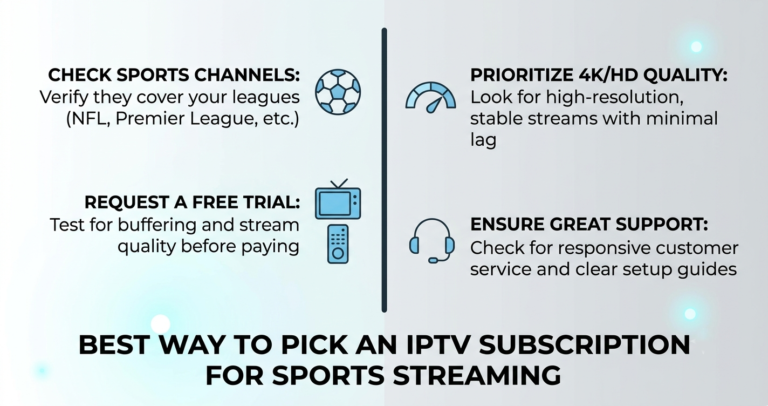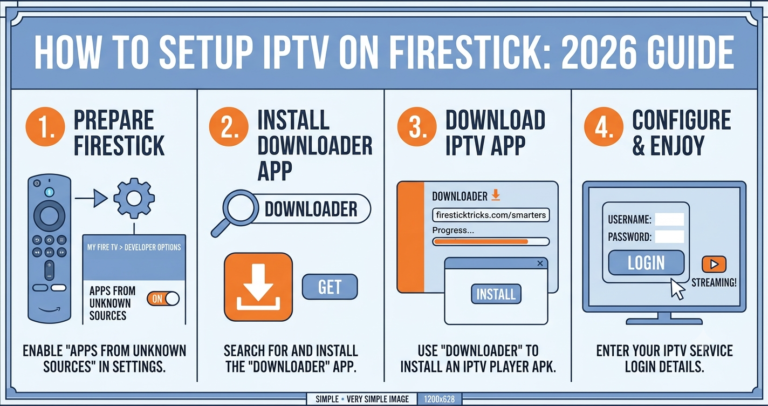
Why an Instant Free IPTV Trial Is the Only Smart Way to Buy IPTV in 2026
Nobody wakes up wanting to throw money at a service that buffers every ten minutes. Yet thousands of subscribers do exactly that every single week because they skipped the one step that could have saved them — requesting an instant free IPTV trial before committing a penny. The IPTV market in 2026 is flooded. Panels are cheap to spin up, resellers multiply overnight, and the average buyer has no reliable way to separate a polished landing page from a genuinely stable service. A trial fixes that problem in hours, not months.
This article is written from the operator side. Not theory. Not recycled “top 10 IPTV” fluff. What follows is a breakdown of why trials exist, what you should actually test during one, what providers are hiding when they refuse to offer one, and how UK IPTV resellers themselves can use an instant free IPTV trial as the single most powerful conversion tool in their arsenal.
If you sell IPTV, you need to understand trial psychology. If you buy IPTV, you need to understand trial mechanics. Either way, you are in the right place.
What Happens During an Instant Free IPTV Trial That Matters
Most people treat a trial like a quick channel surf. Open the app, flick through a few streams, see a picture, and decide. That approach tells you almost nothing. An instant free IPTV trial is a diagnostic window. Treat it like one.
During those 24 to 48 hours, you are not checking whether channels exist. You are checking whether they hold up. There is a massive difference between a stream that loads and a stream that survives peak-hour congestion on a Friday night when half of Europe is watching the same fixture.
Here is what actually matters during your trial window:
- Peak-hour stability — Test between 7 PM and 11 PM local time. If it buffers then, it will always buffer then.
- Channel-switch latency — How many seconds between pressing a channel and seeing video? Anything over three seconds on a wired connection signals HLS latency issues at the server level.
- EPG accuracy — A broken or outdated electronic programme guide means the provider is not maintaining their panel. That laziness extends to server maintenance too.
- Catch-up and VOD loading — These pull from different CDN paths. If live works but VOD stutters, the provider is skimping on storage-tier bandwidth.
Pro Tip: During your instant free IPTV trial, open two devices on the same connection simultaneously. If the second device buffers while the first does not, the provider is throttling multi-connection use — a sign they oversell credits to resellers.
Why Some Providers Refuse to Give an Instant Free IPTV Trial
This is the section nobody writes because it makes half the market uncomfortable. If a provider will not offer any form of trial, ask yourself one question: what are they protecting you from seeing?
There are three real reasons providers dodge trial requests. The first is oversold infrastructure. When a panel operator sells more credits than their server cluster can handle, every new viewer degrades quality for existing ones. A trial user is pure cost with no guaranteed return, so they cut the exposure.
The second is DNS poisoning vulnerability. Providers operating without redundant DNS routing know that a trial user testing during an ISP-level block event will immediately see failures. That first impression kills conversions. So instead of fixing the infrastructure, they eliminate the window where the flaw would be visible.
The third is churn math. Some operators run the numbers and realise their 72-hour churn rate after trial activations is above 60%. Rather than improve the service, they remove the trial and rely on impulse purchases and no-refund policies.
Pro Tip: A provider who confidently offers an instant free IPTV trial is telling you something important — they trust their infrastructure under observation. That confidence is earned, not performed.
The Reseller Angle: How an Instant Free IPTV Trial Converts Better Than Any Discount
If you are a reseller reading this, stop offering 20% discount codes. They attract bargain hunters who churn in 30 days. An instant free IPTV trial attracts a fundamentally different buyer — someone who wants proof before commitment. That person, once converted, stays for six months or longer because they made an informed decision.
The conversion psychology is straightforward. A discount says “we need your money.” A trial says “we do not need to convince you — the service will.” One positions you as desperate. The other positions you as confident. Subscribers feel that difference even if they cannot articulate it.
| Strategy | Avg. Conversion Rate | 90-Day Retention | Perceived Trust |
|---|---|---|---|
| Discount Code (20%) | 12–18% | 35–40% | Low |
| Instant Free IPTV Trial (24h) | 28–38% | 65–72% | High |
| No Trial, No Discount | 6–9% | 50% | Neutral |
Those numbers come from watching reseller panels across multiple provider ecosystems over the past two years. The pattern holds. Trials outperform discounts on every metric that actually matters to a reseller building a sustainable book of subscribers.
What Your Instant Free IPTV Trial Should Include — and What It Should Not
Not all trials are equal. A provider handing you a 2-hour window with 50 channels unlocked is not giving you an instant free IPTV trial. They are giving you a trailer. A real trial mirrors the full subscription experience so your test results actually predict what paying for the service will feel like.
A credible trial includes:
- Full channel list access, not a trimmed demo package
- EPG and catch-up functionality enabled
- At least 24 hours of duration, ideally 48
- Multi-device allowance matching the paid plan
- VOD library access, not just live streams
What it should not include is unlimited duration. Providers who offer “free forever” tiers are monetising you differently — usually through data harvesting or injected ads inside the stream. That is not a trial. That is a product with a hidden cost.
Pro Tip: Ask the provider whether your instant free IPTV trial runs on the same server cluster as paid accounts. Some operators route trial users through a dedicated “showcase” server that performs better than production. If your trial and subscription feel like two different services, that is exactly what happened.
Load Balancing and Why It Determines Your Trial Experience
Here is where the infrastructure conversation gets real. The reason your instant free IPTV trial buffers at 9 PM but works perfectly at 2 PM is almost never your internet connection. It is load balancing — or the lack of it.
A properly architected IPTV backend distributes viewer connections across multiple uplink servers. When one node approaches capacity, new connections route to the next available node. This is not optional for any provider serving more than a few hundred concurrent viewers. It is the baseline.
Budget providers skip this entirely. They run a single origin server, maybe two, and hope demand stays under capacity. During off-peak hours, the service looks flawless. During peak hours, it collapses. Your trial timing determines which version of reality you witness.
This is why testing during peak hours is not optional — it is the entire purpose of requesting an instant free IPTV trial in the first place.
- Single-origin setups — Fail predictably above 300 concurrent streams
- Dual-node with no load balancer — Manual failover, meaning minutes of downtime during switches
- Proper load-balanced clusters — Seamless distribution, minimal HLS latency spikes, and automatic failover if a node drops
ISP Blocking in 2026 and What It Means for Your Trial
You cannot evaluate a service properly without understanding the blocking landscape. In 2026, AI-driven ISP blocking has moved beyond simple URL blacklists. Major broadband providers across Europe and parts of North America now deploy deep packet inspection combined with machine learning classifiers that identify IPTV traffic patterns even when encrypted.
What does this mean for your instant free IPTV trial? It means a service might work perfectly on Monday and fail on Thursday — not because the provider changed anything, but because your ISP updated its classifier. A quality provider accounts for this with rotating delivery domains, DNS-over-HTTPS fallback, and backup uplink servers that activate when primary paths get flagged.
During your trial, test this deliberately. Switch between a standard connection and a VPN. If the service only works behind a VPN, the provider has no anti-blocking resilience built into their infrastructure. That is a maintenance burden that falls on you as the subscriber, and it is a red flag for long-term reliability.
Pro Tip: Providers who survive ISP enforcement waves invest in multi-CDN delivery paths. Ask whether they rotate origin domains automatically or rely on manual DNS updates. The answer tells you everything about their operational maturity.
Panel Credits, Pricing Models, and How Trials Fit into the Reseller Economy
For resellers, an instant free IPTV trial is not just a sales tool — it is a cost centre that needs managing. Every trial you issue burns a credit from your panel. If your provider charges you per activation regardless of whether it converts, your trial strategy needs a qualification layer.
Smart resellers do not hand out trials to anyone who asks. They qualify first. A quick conversation about what the prospect watches, which devices they use, and whether they have tested other services filters out tyre-kickers who will consume your credit and vanish.
The credit economics look roughly like this:
- Average panel credit cost per trial activation: £0.15–£0.40
- Conversion rate with qualification: 35–45%
- Conversion rate without qualification: 15–22%
- Break-even point: approximately 3 converted subscribers per 10 trials issued
That margin is workable if you are selective. It becomes a drain if you post “DM for free trial” on every forum and social channel without filtering. The instant free IPTV trial is a precision tool. Use it like one.
Testing Checklist: What to Do in Your First 60 Minutes
The first hour of your instant free IPTV trial sets the diagnostic baseline. Do not waste it browsing. Execute a structured test:
- Connect via wired ethernet if possible. This eliminates WiFi variables from your results.
- Open a premium sports stream and a news stream side by side. Sports is bandwidth-heavy. News is lightweight. If news buffers, the problem is server-side, not content-related.
- Check zapping speed across 20 channels. Time each switch. Average anything above 2.5 seconds and note it.
- Navigate to the VOD section. Pick a title added within the last 48 hours. If recent additions buffer while older titles play fine, the provider is not pre-caching new content properly.
- Force-close the app and reopen. If your session does not resume cleanly, the authentication handshake has issues that will annoy you daily.
This structured approach extracts more insight in 60 minutes than casual browsing does in 48 hours. An instant free IPTV trial is only as valuable as the rigour you bring to it.
Household Buyers vs. Resellers: Different Trial Priorities
A family subscribing for home viewing and a reseller evaluating a new provider have completely different priorities during an instant free IPTV trial, and the testing methodology should reflect that.
Household buyers care about channel availability in their language and region, EPG accuracy for scheduling recordings or reminders, and device compatibility across smart TVs, tablets, and phones. They want to know that the service works the way their old cable subscription did — reliably and without technical intervention.
Resellers care about uptime guarantees, panel responsiveness, credit pricing tiers, multi-sub management, and how the provider handles mass outages. A reseller who activates 200 subscribers needs to know that when something breaks at 8 PM on a Saturday, there is a support channel that actually responds.
- Household priority: Picture quality, channel selection, EPG, family-friendly interface
- Reseller priority: Panel speed, credit cost, bulk activation tools, provider communication during incidents
Pro Tip: If you are a reseller running an instant free IPTV trial on a new provider, activate five test lines simultaneously and monitor them across different devices and ISPs. A single trial line tells you about the stream. Five tell you about the infrastructure.
Red Flags That Surface Only During a Trial
Some problems are invisible until you actually use the service. That is the entire value proposition of an instant free IPTV trial. Here are patterns that only emerge under real testing conditions:
Forced app updates mid-session. If the provider pushes an APK update during your trial that requires reinstallation, their deployment pipeline is unstable. That disruption will happen to your paying subscribers too.
Geo-locked content appearing and disappearing. Some providers inject geo-locked streams into the full channel list. They show up in the guide but fail when selected. This inflates the channel count on paper while delivering a worse actual experience.
Audio-video sync drift on long viewing sessions. Watch a single channel for 90 minutes continuously. If the audio drifts out of sync gradually, the transcoding pipeline has a clock-drift bug that the provider either does not know about or has not prioritised fixing.
DNS resolution failures after midnight. Some budget providers reduce their DNS redundancy during off-peak hours to save costs. If your instant free IPTV trial fails to load channels between midnight and 6 AM, this is likely the cause.
Building Trust as a Reseller Through Transparent Trials
The IPTV reseller market in 2026 is a trust deficit environment. Buyers have been burned. They have paid for annual subscriptions that died in three months. They have been ghosted by Telegram resellers who vanished after collecting payment. Against that backdrop, offering an instant free IPTV trial is not generosity — it is positioning.
When you let a prospect test before paying, you are making a statement about your infrastructure, your confidence, and your intent to operate long-term. That statement differentiates you from 90% of the market without spending a penny on advertising.
Pair the trial with a simple onboarding message: what to test, how to reach support during the trial, and what the paid experience includes beyond the trial window. This structure converts casual testers into committed subscribers because it demonstrates operational professionalism.
Resellers who treat the instant free IPTV trial as a throwaway freebie miss the point entirely. It is your best sales conversation, delivered silently through the product itself.
Frequently Asked Questions
How long should an instant free IPTV trial last?
A meaningful instant free IPTV trial should run for at least 24 hours, ideally 48. Anything shorter does not give you enough time to test during both peak and off-peak windows. Two-hour trials are marketing gimmicks, not genuine evaluation periods. You need a full evening cycle at minimum to see how the service handles real-world demand.
Can I test multiple devices during an instant free IPTV trial?
That depends on the provider’s trial policy. A credible provider will mirror the multi-device allowance from their paid plans during the trial. If they restrict you to one device during the trial but advertise multi-screen support on their paid plan, ask why. The answer usually reveals infrastructure limitations they would rather you discover after payment.
Why do some IPTV providers not offer any trial?
Providers who refuse trials typically have infrastructure they do not trust under scrutiny. Oversold server capacity, inconsistent uptime, or vulnerability to ISP blocking are the most common reasons. A no-trial policy is not always a dealbreaker, but it should raise questions about what the provider is avoiding.
Is an instant free IPTV trial enough to judge long-term reliability?
No single trial can guarantee long-term performance, but it reveals baseline quality. Server response times, HLS latency, EPG maintenance, and peak-hour stability during a trial are strong indicators. If a provider cannot deliver a stable 24-hour trial, expecting a stable 12-month subscription is unrealistic.
How do resellers manage trial credit costs effectively?
Successful resellers qualify prospects before issuing trials. A short conversation confirming device compatibility, viewing habits, and genuine purchase intent filters out casual browsers. This qualification step can push trial-to-conversion rates above 40%, making the credit cost per acquired subscriber commercially sustainable.
Does using a VPN during an instant free IPTV trial affect results?
Yes, and deliberately so. Testing with and without a VPN during your instant free IPTV trial reveals whether the provider has built ISP-blocking resilience into their delivery infrastructure. If the service only works behind a VPN, the provider relies on you to solve a problem they should be solving at the server level.
What channels should I test first during a trial?
Start with premium sports streams during live events — they consume the most bandwidth and expose server weaknesses fastest. Then test international news channels for baseline stability, followed by VOD content for CDN performance. This sequence gives you a complete picture of infrastructure quality within the first hour.
Can a reseller offer an instant free IPTV trial without losing money?
Absolutely. The credit cost per trial is typically under £0.40. With a qualified conversion rate of 35–45%, a reseller recovers trial costs within the first month of a converted subscriber’s payment. The real loss comes from not offering trials and competing on price alone, which attracts high-churn, low-loyalty subscribers.
Your Instant Free IPTV Trial Success Checklist
- Request a minimum 24-hour trial from any provider before purchasing — no exceptions
- Test during peak evening hours between 7 PM and 11 PM, not during the afternoon
- Run simultaneous streams on two devices to check multi-connection throttling
- Compare performance with and without a VPN to assess ISP-blocking resilience
- Time your channel-switch speed across at least 20 channels and flag anything above 2.5 seconds
- Verify EPG accuracy and catch-up availability — neglected EPG signals neglected servers
- Ask the provider whether trial and paid accounts share the same server cluster
- If you are a reseller, qualify prospects before issuing trial credits to protect your margins
- Track your trial-to-conversion ratio monthly and adjust your qualification criteria accordingly
- Visit britishseller.co.uk to explore a UK IPTV reseller ecosystem built on transparent trial-first onboarding